Ar. Mahmudul Anwar Riyaad, Dhaka
Winners of Commendation Award - Foreign Countries' Architecture Awards (FCAA)
Project Name:
NOORUDDIN COMPLEX
Year of Commencement:
2019
Year of Completions:
2023
Name of Firm:
DWm4 Architects
Location:
Narayanganj
Size:
14096 Sq. m
Project type:
Public Building
Project Description
Nooruddin Complex at Nabiganj, Narayanganj is a multipurpose community center run by Epyllion Foundation. Nabiganj is a remotely located and organically grown peri-urban settlement mostly inhabited by lower middle class families. The area is densely populated and completely deprived of any kind of social infrastructure.
Epyllion Foundation is the CSR wing of Epyllion Group – a family run business conglomerate. Nooruddin Complex, established and run by the Foundation, is named after the late head of the family whose ancestral village is Nabiganj. The project was conceived by the next generation of the family, who themselves grew up in the neighborhood and were pained by the lack of spaces that instill positivity in the evolving minds of the contemporary youth of the area.
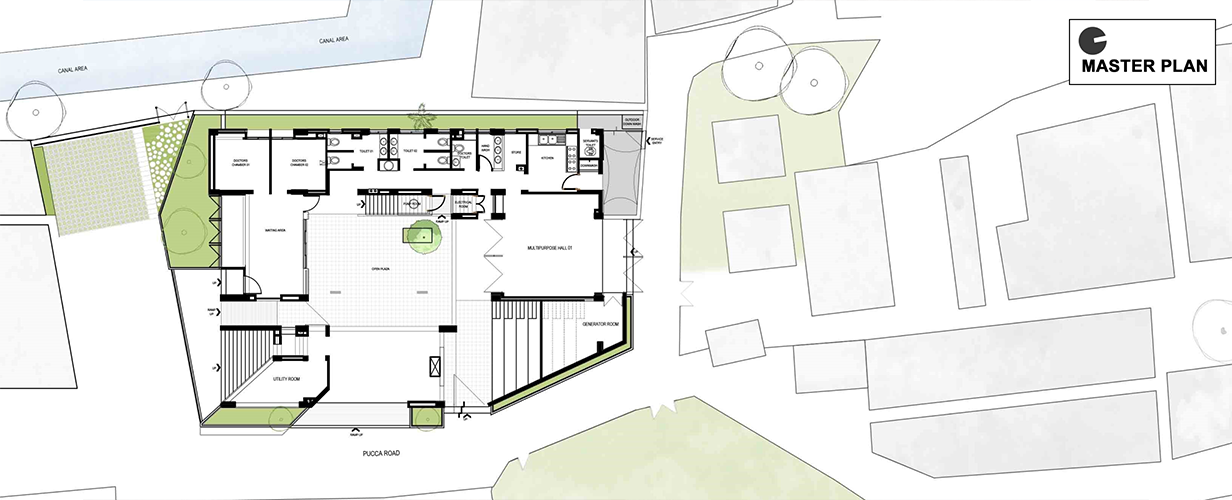
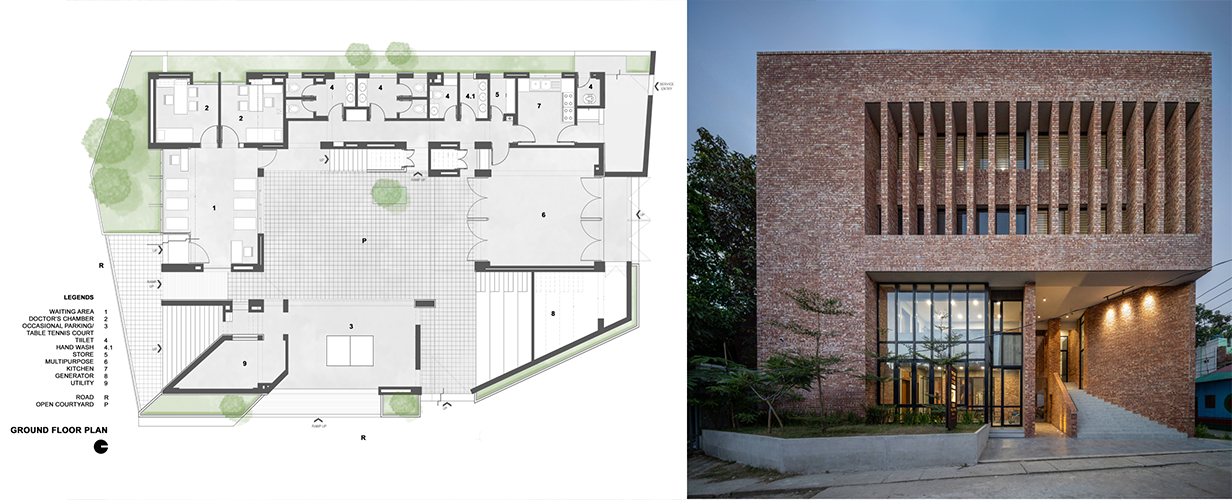
The program of the project was formulated through discussions with it’s intended users – the residents of the neighborhood. The functions accommodated in the Complex include Doctors Chambers, a small Pathological Laboratory, 2 Hall Rooms for multi-purpose community use like hosting social dining and watching cricket matches in large groups, Library, Gymnasium, 6 classrooms for after-school tutorials and an outdoor Gallery for open-to-sky art classes for the children and young of the neighborhood.
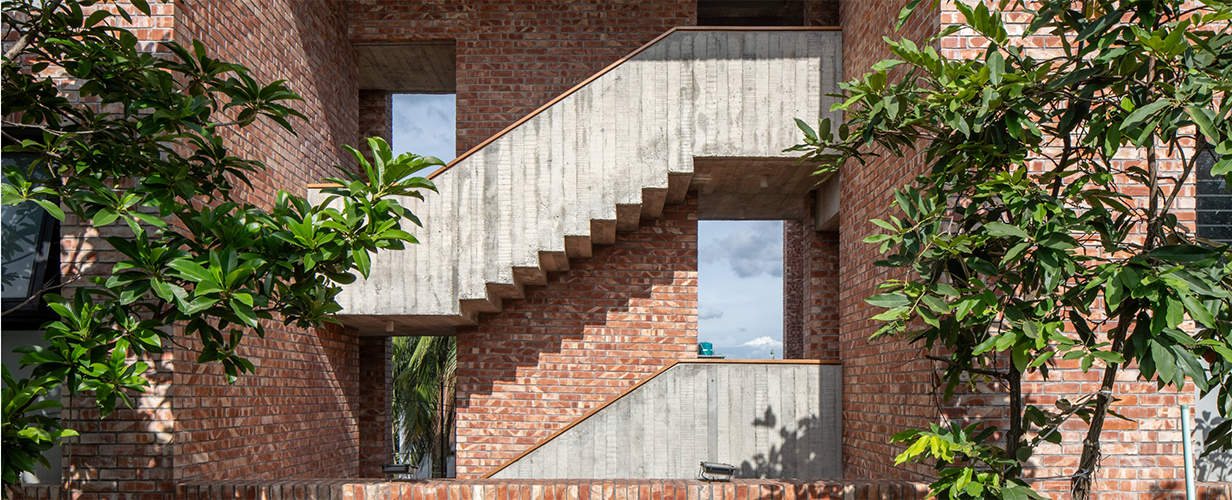
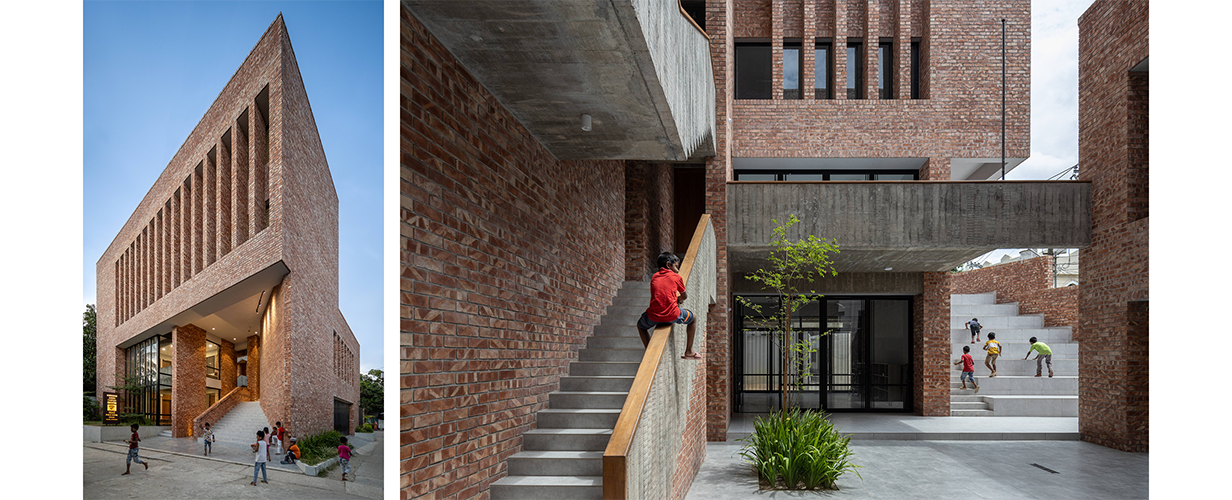
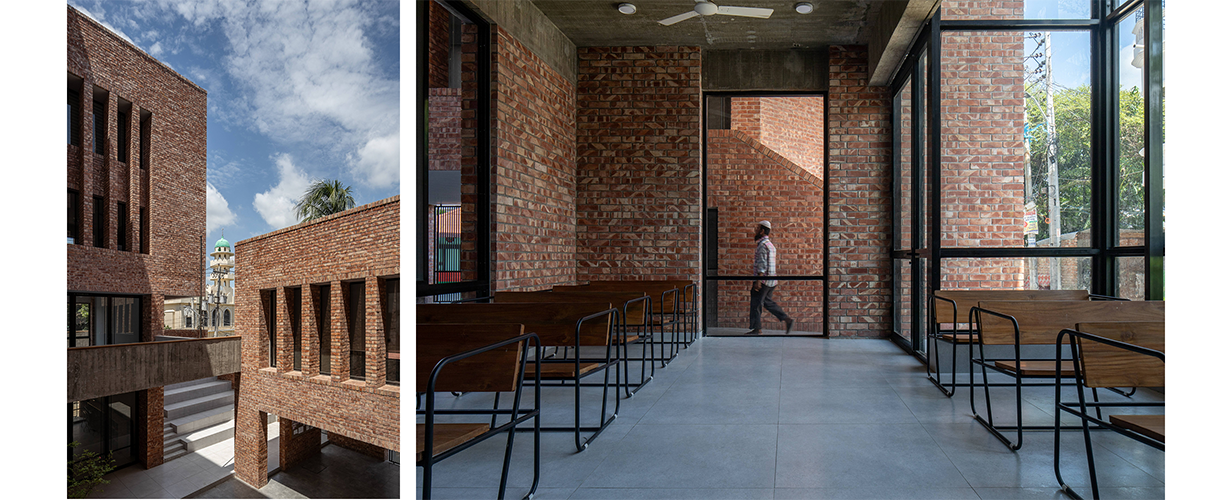
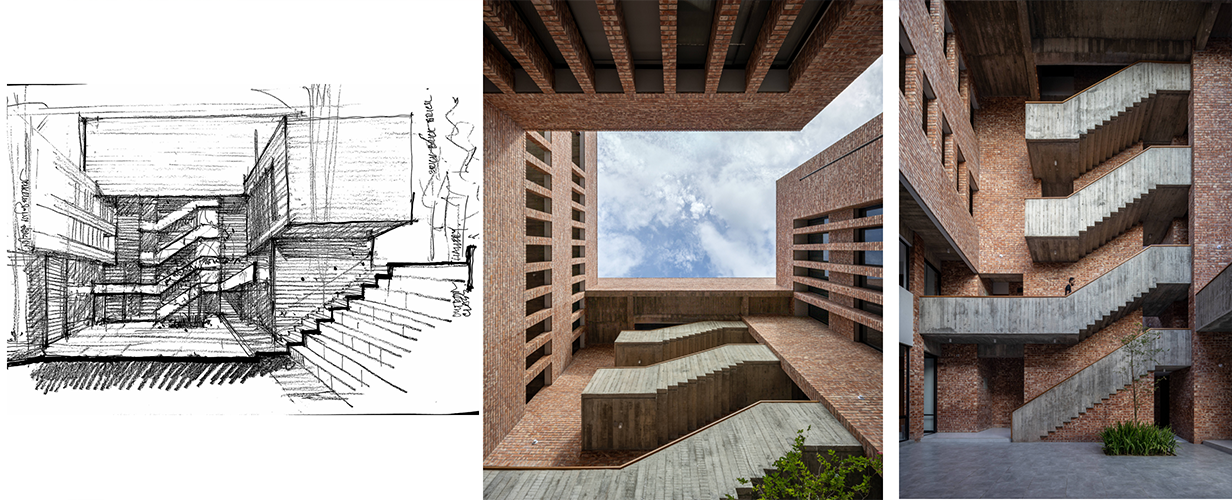
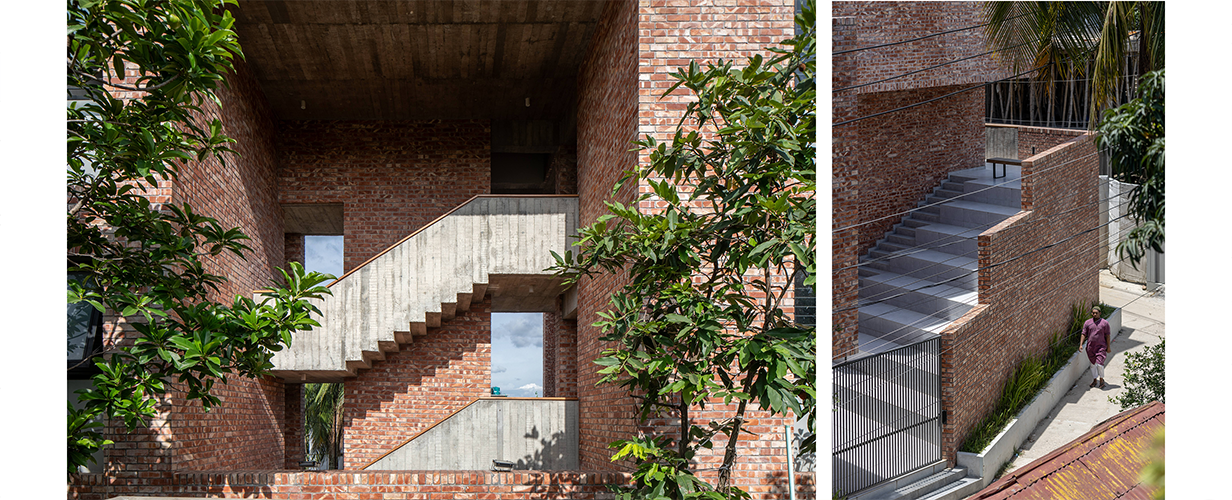
Brick is the principal building material – a logical choice due to its availability and economy of construction and maintenance. Rooms are oriented in North-South direction with thick brick walls and louvers acting as thermal mass. Parts of three-dimensional mass shifts randomly to respond to the organic character of the dense surrounding. The statement is bold yet soft, with the texture of solid brick masses forming varying perspectives when viewed from adjacent alleys. Once inside, it is the contrasting openness of the Courtyard that connects with the outside at different levels. Space flows in different directions, with concrete parapets of the exposed stair acting like counterweights to the central void.
1_ARCHITECTURAL CONCEPT
Creating a social hub for the community, in and around a built form that welcomes the from all direction irrespective of age, religion and gender. A building made of local material and by local craftsman with familiar technology. Perceived as a building without boundary wall and with entries from all sides. A building that makes the community proud.
2A_SITE AND CONTEXT ANALYSIS
– Description of the Project Locale (Include description of the Architecture/ Design of the Area, and how the Project integrates into the Climatic/Cultural/Architectural Environment of the Area)
Located in a dense fabric of low rise buildings in a peri-urban context. At a dead end of a narrow winding road. Pre dominantly a residential area inhabited by low and lower income community deprived of social infrastructures at a community level.
2B_BREIFLY DESCRIBE SOME OF THE KEY CONSTRAINTS AND OPPORTUNITIES OF THE PROJECT AND HOW THE DESIGN SOLUTION ADDRESSED THEM
Since its a building dedicated to a an otherwise neglected community and also run by a charitable organization , budget was a big constraint . Choice of material , choice of construction technique , multiple use of spaces, accommodating changes, cost of running and maintenance etc were given priority.
03_DESCRIPTION OF PROJECT DETAILS
– Describe the project and highlight the special features, supporting facilities and landscape design, etc.
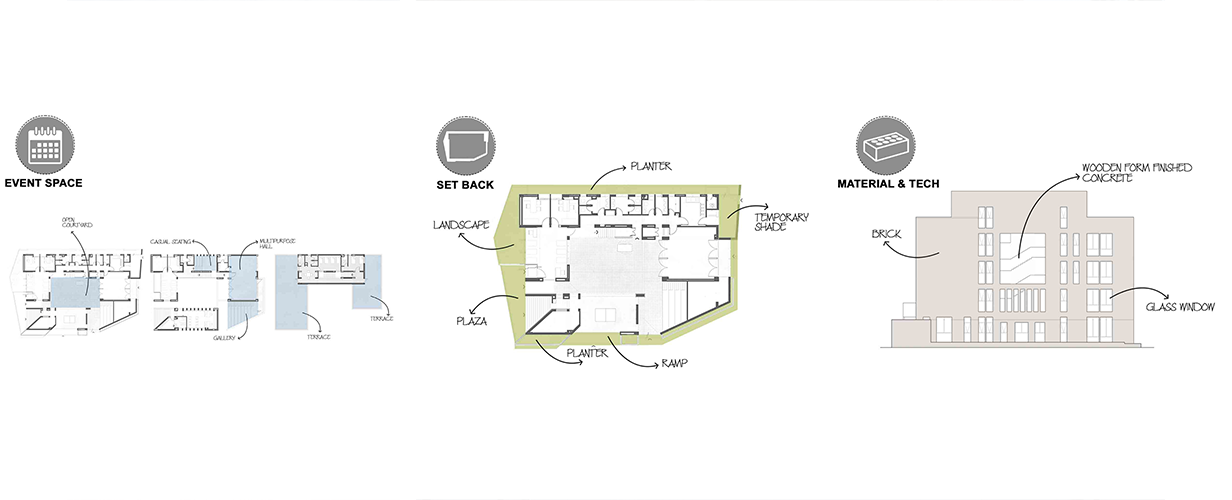
The idea of the built form and its functions were perceived through discussions at community level- the lack of social spaces which would spur new ideas of innovation were extensively addressed by adding features like open courtyard, casual seating areas, multi-purpose hall, gallery and so on.
The building was offset from the site- smaller footprint built to reduce volume which in turn facilitated in forming connections to the urban fabric.
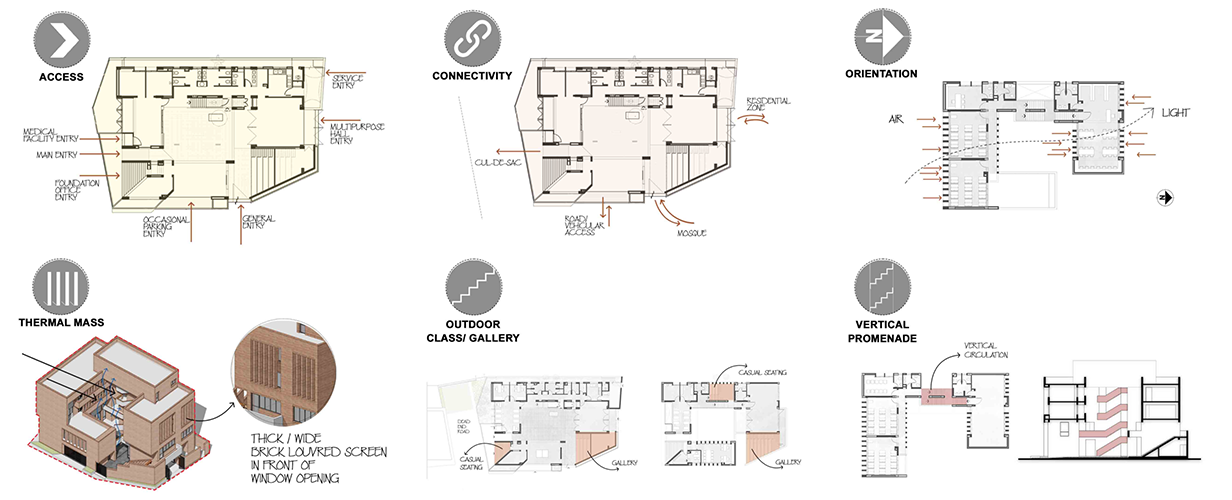
The orientation of the building and size of the volumes were carefully curated to ensure air to be drawn in onto the public spaces, markedly the internal courtyard and flow through to reach the upper floors.
The vertical promenade cast in wooden form finished concrete forms a sculptural entity naturally ventilated through the open internal courtyard.
04_Significance of the project
– In what way is this project important? Please describe the aspect(s) of the project, which you feel represent a particular achievement, for example the technical, economic, or social achievement, or its response to culture or climate. etc.
- Connecting the members of the community physically, psychologically and emotionally with a sense of belonging and pride. Its connectivity with immediate surroundings welcomes everyone from the community,
- its austere walls in bare brick and concrete surrounding the central void offers silence and a sense of repose. Playful stairs rise vertically to give hope and the stepped galleries, large and small, offers scopes to share ideas as well as to enter a reflective mode.
05_Areas of Innovation
– In what areas is this building exemplary? How does it stand out from its peers?
The contrasting solidity from the exterior breaks free when walking through to reach the open-air courtyard. The courtyard forms the heart of the structure connecting all functional aspects of the building, tying them as a whole.
The uniformity of material forms a backdrop, a façade for the random urban landscape. Parts of three-dimensional mass shifts randomly to respond to the organic character of the dense surrounding. The statement is bold yet soft, with the texture of solid brick masses forming varying perspectives when viewed from adjacent alleys, creating interesting vistas.
06_Details of Sustainable Architecture
– How does the project address the criteria for sustainability? Why does it deserve a special award?
Sustainability Engagement and Performance, e.g. Demonstrates strategic commitments to combat climate change; Stakeholder.
Environmental Quality and Well-being, , e.g. Promotes health and well-being; values ecological, social and cultural aspects of the site and surrounding neighbourhood.
Resource Conservation,e.g. Promotes net zero-energy, low carbon emissions, and innovative use of renewable energy sources; Reduction in material and resource consumption from a life-cycle perspective; Effective waste management and pollution control.
Orientation of built form – Longer façade aligned in the North-South Axis with deep openings formulated by shifting volumes, creating a natural path for wind and air flow to the interiors.
Choice of material – Brick was deemed as the obvious choice due to availability, economy of construction, ease of maintenance and familiar technical know-how.
Thermal mass – Use of thick wide brick louvred screen-like formation placed before glass cut-off sun resulting in lower internal temperatures.
Local and cost-effective technology to improve soil condition – Piling works to enhance soil load bearing capacity was avoided by the technology of excavating existing soil mass and replacing with new soil which was in turn compacted to gain strength and stability.
07_Details of Socially Responsible Architecture
– How does the building address the criteria for socially responsible architecture? Why does it deserve a special award?
Social inclusiveness, e.g. Accessible to all; Universal design; Care for the vulnerable or underprivileged.
Delivering Positive impact beyond architecture, e.g. Natural resources; Social equality, justice, values; Policy and legislature; Local economy and jobs; Urban ecology and infrastructural systems; Partnerships and stakeholder diversity.
Outcomes and processes sensitive to local needs, e.g. Community resiliency against disasters; Quality of place/space – comfort & ease of use; Culturally sensitive design features; Affordable, Cost effective solutions; Efficient use of locally scarce resources; Participatory design and construction processes; Choices of materials, building systems and equipment; Construction techniques.
This project is dedicated to the community, from program formulation to everyday operation of the project is participated by the community. All the programs here from doctors clinic to gymnasium , from Library to classrooms , from dining hall to TV lounge every single square foot of the complex is dedicated for the members of various age groups from the immediate community of Nabiganj.
08A_Users’ Profile & Response
– Describe how the design addressed the needs to each user profile of the building.
Every activity in this complex is almost or absolutely free for the members of the community . Every one is attached with the project and thus its the center of life in that small and otherwise neglected community. It also provide them with a sense of empowerment and emancipation and relieve them to a certain degree from the mental and financial burden.
08B_Describe the users’ response to the building e.g. the operational experience as a result of the choice of material or technical installation.
Extensive use of thick brick walls impacted in lowering the overall internal temperatures- creating a comfortable environment to function. Extensive use of local materials like brick and concrete rendered the building to be maintenance free.
09_Innovative Project Technology
– Highlight any innovations in construction technology, structural system, material use, building services, site utilities, digital technology, etc.
Soil improvement – Piling works to enhance soil load bearing capacity was avoided by the technology of excavating existing soil mass and replacing with new soil which was in turn compacted to gain strength and stability.
Thermal Mass – Use of thick wide brick louvred screen-like formation placed before glass cut-off sun resulting in lower internal temperatures.
Locally available material – Brick was deemed as the obvious choice due to availability, economy of construction, ease of maintenance and familiar technical know-how.
Covid 19 – The construction phase was entirely carried out and super-vised during the covid pandemic (2020-2021). Constant super-vision and collaboration with all aspects of building process had to be done remotely which provided challenging in order to achieve the desired level of precision in construction.