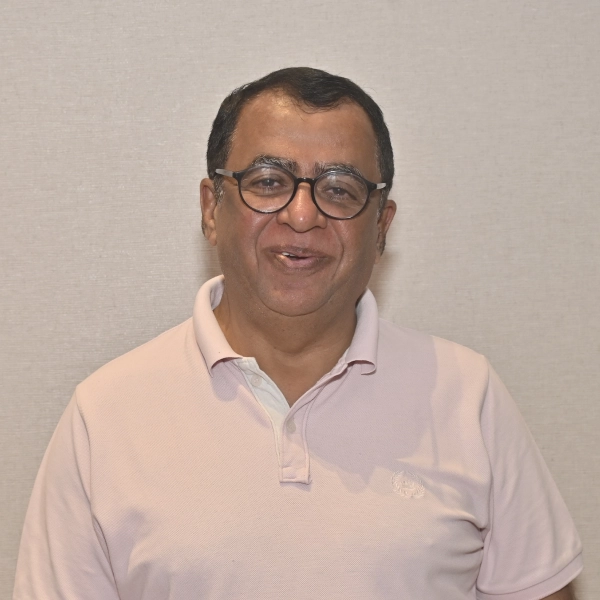
Prof. Charanjit S Shah
Founding Principal
Bachelor of Architecture, School of Architecture & Planning, New Delhi (1970)
Registered Architect CA/75/24; (CoA)
Fellowship with Indian Institute of Architects Mumbai (1980);
Fellowship with Institution of Valuers (1987)
Architect, educationist & academician, Prof. Charanjit S Shah established Creative Group in 1973 with a sincere approach towards Green Architecture in India.
He has spearheaded some landmark sustainable projects in India including Swami Vivekananda Airport at Raipur, India and Kamraj Airport Terminal at Chennai, India.
Led by Prof. Shah, Creative Group has also designed the Multimodal hubs for Ahmedabad‐Gandhinagar Metro, Chennai Airport Metro, Goa and Vodadara Airports, 50 Years conceptual Master plan for the city of Jamshedpur.
With an inclination towards teaching, he joined SPA, New Delhi in 1996 as a faculty & thereafter became the Director at Vastu Kala Academy, New Delhi.
His passion for architectural education made him an honorary recipient of Professor Design Chair from the Jamia Milia Islamia University in New Delhi.
He has authored several books on Architecture like Kitchen, Bathroom, Water supply & sanitation with emphasis on broad explanation of building services & management, structure, professional practice, etc.
The “Architects’ Handbook ‐ A Ready Reckoner” authored by Prof. Shah is a de‐facto standard text used for academic & professional community.
Prof. Shah has been the Chairman of the Indian Institute of Architects, Chairman ‐ SAARCH, Founder Secretary General, Guild of Practicing Architects, Secretary General & Chief advisor, Archi Design Perspective, New Delhi, Professional advisor, J.K.Architects of the year awards, Professional advisor, Montgonery International, U.K., Consulting editor ‐ American Biographic co., New York, Member of World Peace Mission of India (2001‐ till date).
Recently, Prof Shah Practice has been recognized by Architecture + Design Magazine March 2013, which entails life coverage of Prof Shah in the field of sustainable practice.
He has also been facilitated with CBR Global Transport Engineering Lifetime Achievement Award 2014 in Mumbai.
How can redevelopment of desolate and untended spaces in a city help make the given area active and exuberant?
Should the Shankar Market Precinct reflect the essence of its historically significant context?
Why Shankar Market? Why redevelopment?
For my thesis, I wanted to design a space where I would be able to test my skills—from developing the programme to creating a design for a very diverse audience: shoppers, office-goers, young mothers, art enthusiasts, and food lovers in the hub of the city.
The city of Delhi is constantly engulfing its surrounding land and increasing its perimeter instead of reviving redundant and dilapidated spaces in the heart of the city. Looking at such spaces, I decided to redevelop an area in central Delhi that is not living up to its full potential. The site I chose is the CP extension consisting of:
Super Bazaar – This was the first shopping area to open in Delhi, housing all the various needs and requirements of middle-class shoppers under one roof. It has been sealed for the last 12 years due to lack of maintenance and structural instability.
Campa Cola Factory – This building has also been lying redundant for the last 7 years due to internal litigations. Campa Cola was India’s first aerated drinks company.
Shankar Market – A very popular local shopping centre for textiles that has been around for over 50 years. It is only two storeys high and does not use its site to its full potential. The complex is totally dilapidated and in dire need of redevelopment.
Mayur Bhawan – This building houses the income tax department. Though it wasn’t part of my original proposition, it needed to be included as it didn’t sit comfortably in the current design and was turning into an island in a large road roundabout.
A site like this has a lot of potential as it is located near Connaught Place and is well connected by public transport. The force acting most persistently against the cultivation of good public space is “car culture,” which has completely destabilised pedestrian life. The critical relationship between public space and pedestrian life is currently lacking due to the prioritisation of car culture. As one of the main exits of the Shivaji Bridge Railway Station is adjoined to the site, pedestrian movement is a vital part. The design creates a space where pedestrians have been given priority and the vehicular roads are only on the periphery. To create smooth movement patterns in and around the site, some of the surrounding roads were changed in the design, making the project reach an urban design level by conquering all the issues in the immediate surrounding public spaces as well.
The current ground coverage (GC) of the chosen site is 9,738 m², while with the new design, only 7,891 m² is allowed. The GC can only be 25%, and FAR needs to be 150. This allows the built-up to be 46,929 m² while it currently is 28,718 m². That’s almost 20,000 m² more built-up than the present. The current area used by the inhabitants is 12,614 m², while that achieved in this project is 47,000 m²—catapulting the space into 4 times its current usage area.
Studying the buildings from the perspective of their structure, life remaining, volumes, and functions that can fit into them, I decided to redevelop Shankar Market, Mayur Bhawan, and Super Bazaar, while the Campa Cola Factory would undergo adaptive reuse. This was because its structure was stable and allowed for other functions like exhibition halls to easily fit in with minor retrofitting.
The site and its surroundings were studied in terms of space distribution, infrastructure, parking, entry/exit points, ease of navigation inside the market, navigation around the site, cleanliness, and shopping experience. An edge study was also done for demographics of visitors, vehicles, and activities taking place on all sides of the site currently.
The program was built ground-up and is based around the needs of the surrounding area.
My objectives for this thesis are:
To create a relationship between urban form, pedestrian life, and public space by the effective combination of built, landscaping, and public art.
To create seamless pedestrian connections to its surrounding spaces.
To guide sustainable growth while outlining initiatives to stimulate economic and cultural growth at the city centre.
Increasing green cover in the public domain.
To ensure that the essence of CP and the current Shankar Market in terms of its open spaces, courtyards, and volumes is preserved.
Promote the survival and predominance of small shops, marginal businesses, and other enterprises, activities, and services which are essential to the functioning of the Market.
For example, a daycare facility was added into the design program as the site is surrounded by government and private offices and nuclear families are becoming more and more common in the city. With both spouses working, the demand for daycare facilities is increasing.
Shankar Market’s program is still present, with an increased number of shops.
In the earlier years of Shankar Market, the first floor had skill development workshops like batik classes and typewriting classes. I have brought back these classes with additions such as theatre, ceramics, art, computer, etc.
Additionally, there are exhibition halls and a walking gallery connecting the two sites. Super Bazaar has also been revived.
While keeping in mind the nostalgic value many people attach to the Campa Cola Factory, an aerated drinks museum has been added to the program.
The centre of the city lacks spaces for smaller firms or start-ups to work, therefore common workspaces have been provided. Along with Mayur Bhawan’s offices, commercial standalone offices have also been added to the program.