Mr. Nikhil Maniar
Winners of Architecture Student of the Year Award - Indian Architecture Awards (IAA)
-
Project Name:
Revitalising The Act Of Community Living In The Industrial Cluster Of Morbi
-
Year of Commencement:
-
-
Year of Completions:
-
-
Name of Firm:
-
Location:
Gujarat
-
Size:
-
-
Project type:
-

Project Description
(COM)-P-[ACT]- Revitalising the Act of Community Living in the Industrial Cluster of Morbi, Gujarat
Author- Nikhil Maniar
The phenomenon of people moving from a rural area to a more urban area in search of better job opportunities is age-old. According to Census 2011, 453.6 million people rely on internal migration in India for different reasons and durations, namely to escape poverty, improve the income and lifestyle of their families. The study focuses on internal migration which is further divided into Inter-state and Intra-State migration of labour that is from rural/semi-rural areas to urban areas.
The two aspects i.e migration and urbanization are interlinked, they can be looked at as global as well as local processes that influence both, the areas of destination as well as the origin. Urbanization leads to expansion of the city giving rise to the emergence of housing clusters, Industrial clusters, Special economic development zones along the periphery of the city, thus creating job opportunities. The process of migration to these urban areas is an important pathway out of poverty, diversification of opportunities, broadening one horizon, and simultaneously a process of skill formation. Workers well set in the urban setting having gained knowledge to the recently acquired new skills, usher their relatives and co-villagers to the urban areas, who act as helping hands in contributing to the household income.
The recent resurgence and demand in the potential of small enterprises in promoting employment and economic generation have led to the development and growth of ‘industrial clusters’. A direct relation can be brought about between clustering and urbanization. The development/presence of clusters in small cities or towns provides job opportunities that attract workers from the nearby areas as well as the other states. In addition, it also diverts them from shifting to the already dense metropolitan cities thus creating urban pockets throughout the country. The industrial clusters are home to numerous unorganized and a handful of organized micro, medium and small enterprises (MSME’s), both of which are usually machine-driven, where skilled labour is required to the minimum. The workers approaching these factories are illiterate, young, with an intention of residing in the urban setting for a long time to generate maximum income. Amid their journey to get urban exposure, the workers tend to settle for subpar wages, inferior living conditions, poor working conditions, social exclusion, and no healthcare facilities.
The thesis is a modest attempt to examine an industrial cluster in India and address the problems related to migrant labour in the cluster. An equitable solution will be proposed which will benefit the laborers as well as heighten the productivity of the cluster. The study narrows down to the state of Gujarat, which in recent years has been a favorable destination for migrants. The presence of infrastructural facilities, industrial and economic development makes it an important hub for migrants. Further on, the dissertation narrows down to the town of Morbi, which is home to a booming ceramic cluster and proudly holds the title of ‘The Ceramics Hub of India’. The ceramic cluster is only 6 decades old, however, before gaining the title of the ceramics hub, Morbi was closely associated with the manufacture of building products, namely the roof tiles called ‘Nadiya’. As of today, the cluster houses over 1000 manufacturing units and provides employment to over 60,000 migrants.
The study presents selected findings of research into the living conditions of migrant factory workers in the industrial cluster of Morbi. A total of 7 factories, having 795 workers are surveyed on basis of the product they manufacture, the quantum of production, the type of workers required to manufacture the product, the year of establishment, and the scale of the category they fall under i.e MSME. The sampling method of survey was adopted under which 38 workers from different factories were interviewed. The survey concludes with an in-depth analysis of the living conditions and classifications of the family size of these workers.
After conducting the required research, studying the lifestyle of the migrant factory workers, the thesis aims on improving the lifestyle of the factory workers residing within the cluster by providing a sustainable living environment with a sustainable neighborhood. The objective is to inculcate the idea of a community and neighborhood, fostering interaction between workers of different factories and providing access to public amenities within reach. Reducing ceramic waste by exploring effective construction solutions from ceramic waste is also one of the concerns the thesis would like to address.
The presence of negative patches or empty pockets in-between factory premises within the cluster provide the ideal opportunity to demonstrate the subsequent proposal. The program is envisioned as a prototype, which can be multiplied within the empty pockets, stresses on aspects such as cost-effective and rapid construction using precast construction techniques, while keeping in mind the seismic zone requirements. Before commencing the process of design, analyzing the architectonic elements that go into defining the character of houses in Morbi and their impact on the immediate context help form the founding principles to the design. The idea is to use the context as a “tool box” to understand the character of development in Morbi. Learning from Morbi, finding the essence of development, the character of the streets, the hierarchy of spaces, Identity of the houses, form the basis to the method of proposing a housing scheme catering to the industrial population. Elements such as streets, courtyards, chowks, plinths, otlas, staircases, terraces, dhabas, and self incrementation capabilities define the character of houses in Morbi.
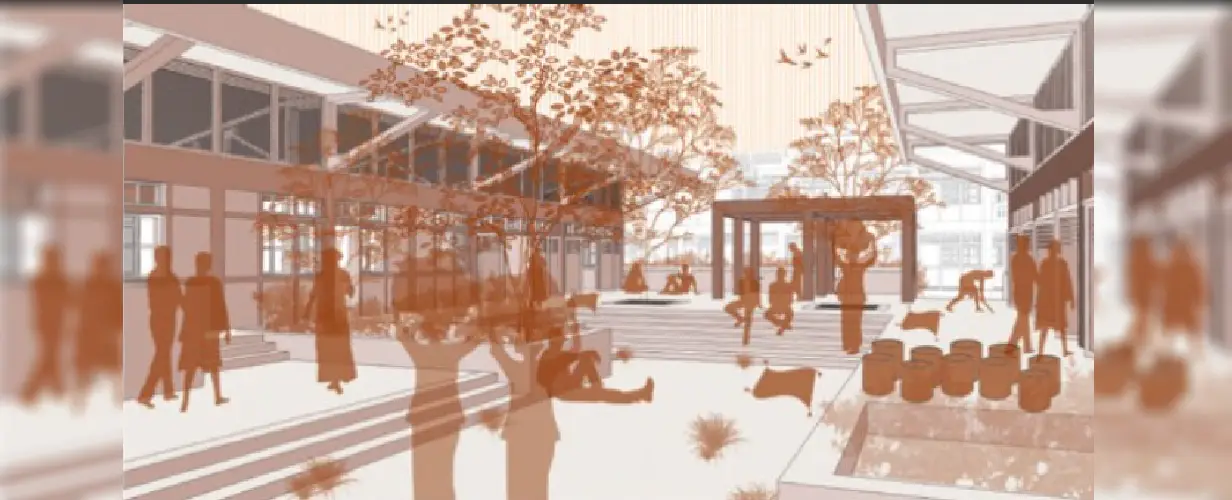
Based on the study of the existing fabric of Morbi and Implementing the principles as studied in the book ‘Eyes on the Street: The Life of Jane Jacobs’, the proposal strives to attain the street character of Morbi by introducing chowks, courtyards, bends along the road to a point where streets no longer just serve the purpose of movement, they develop as key elements for communal interaction. Further on, 2 public amenity structures are provided along the chowks, I.e a schooling facility as well as a vocational training facility. Not only does this ensure activities along the chowks throughout the day, but also caters to an important need of the migrants. In addition to the above, the concept of the housing facility revolves around a base unit, a cube of 3x3x3m, which when multiplied, forms one module, i.e one house. Such agglomerations of modules, when interlocked, flipped, mirrored together form a cluster with pockets of interactive junctions, thoroughfares and terraces. A total of 3 different types of clusters are formulated based on the number of migrants each can accommodate. Besides catering to residential activities, the cluster’s host a series of interactive nodes in the form of a hierarchy of courtyards, otlas and terraces overlooking these. Additionally, each cluster hosts a small public amenity building titled the ‘Vishramalaya’. As the name suggests, it is a resting place, which is porous and multi-leveled hosts a series of public amenities, recreational and interaction spaces within it. Built around a courtyard, amenities such as public toilets, ATM’s, Banks, Doctor’s Clinic, Society Office, Post Office, Kirana Stores, Co-Working space, informal stalls/vendors, drinking water fountains & news-paper stands are proposed. These structures also connect to the terrace, and with the introduction of overhead connections at the terrace/roof level, bind the cluster together by creating a thoroughfare, which induces communal interaction on the floor above.
Based on the living scenario of the workers i.e, Single, Extended Family, Nuclear Family and Joint Family, the modules are designed to cater to the needs of each. The housing module addresses the issues/problems of the migrants by breaking up the module into private, semi-private and shared spaces. The shared spaces, classified as ‘Future Development’ give an economic opportunity to the migrant. For single migrants, who do not see any future prospects of families are provided with dormitories.
The thesis tends to address the complex demands put forth by rapid urbanization, culture, and climate in the industrial environment. The program provides a solution to a complex problem, one which can be seen in all Industrial clusters in India: providing reasonable accommodation to the factory masses. That being said, the envisaged project adopts principles of design from the existing fabric of Morbi, while significantly reducing ceramic waste by using it as raw material as a partial replacement of aggregates and sand during manufacture. The manifesto does adopt certain principles stressed by Ar. Raj Rewal I.e the extensive use of courtyards, scattering of terraces, defining gateways to name a few; however, reinterprets and defines them according to the Industrial setting of Morbi. The proposal, envisioned to improve the quality of life of the migrant factory workers while being self-sufficient aims at becoming an integral part of the industrial setting. It is visualized, the design will eventually blend in with the existing fabric, where it will be used as a thoroughfare by the people residing, working, visiting the vicinity, thus fostering communal interaction.


