Ar. Uday Andhare, Ahmedabad
Winners of Public Building (Commendation Award) - Indian Architecture Awards (IAA)
-
Project Name:
Natarani Theatre
-
Year of Commencement:
-
-
Year of Completions:
-
-
Name of Firm:
-
Location:
Ahmedabad
-
Size:
2100 SQ.M
-
Project type:

Project Description
Natarani Amphitheatre Reinstating a cultural hub for the city.
Location: Ahmedabad Gujarat India I Site area: 6000 sq.m I Built up area: 2100 sq.m
Amphitheatre seating capacity : 385 persons
Climate: Hot dry / humid I Temp: Summer 23 °C/46 °C I Temp: Winter 10 °C/23 °C
Micro climate: Local humidity levels vary due to the proximity of the river.
Cultural backdrop: Natarani Amphitheatre is a unique open to sky amphitheater and an integral part of the world-
renowned Darpana Academy of Performing arts. This is the only state-of-the-arts venue in Ahmedabad city and the state of Gujarat to host high quality performances from around the world. Every year since its inception, there have been about eighty events including dance performances, concerts, plays, cultural programs and films. It has hosted seven major international festivals every year. It also has been the nerve center for young writers, poets, musicians, and activists to hold informed performances.
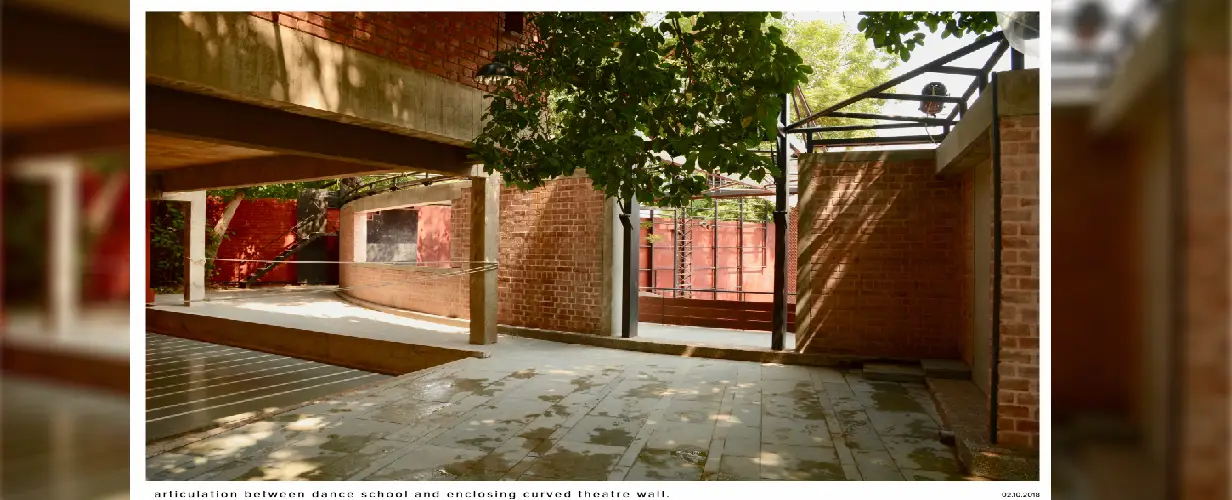
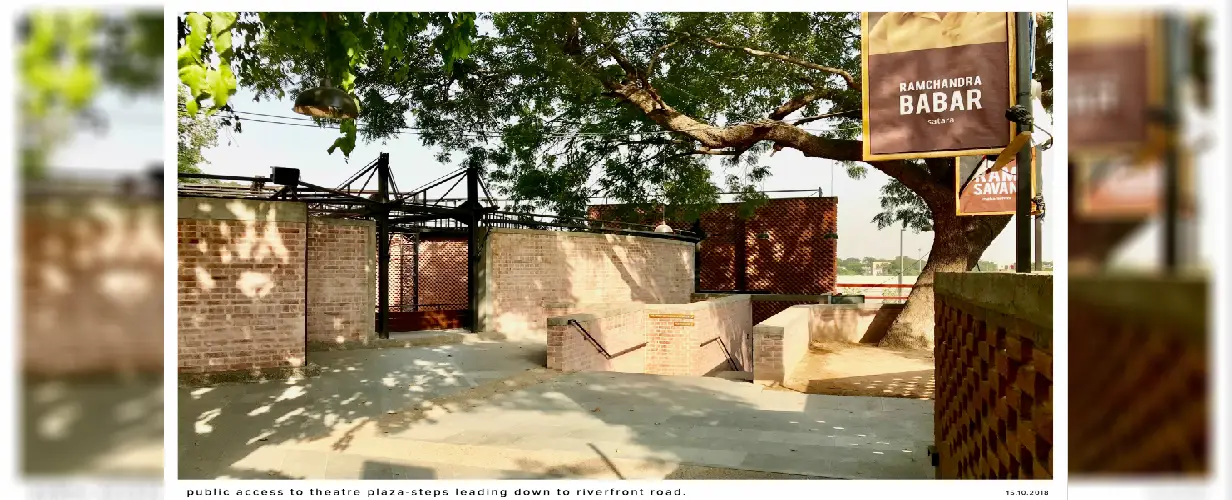
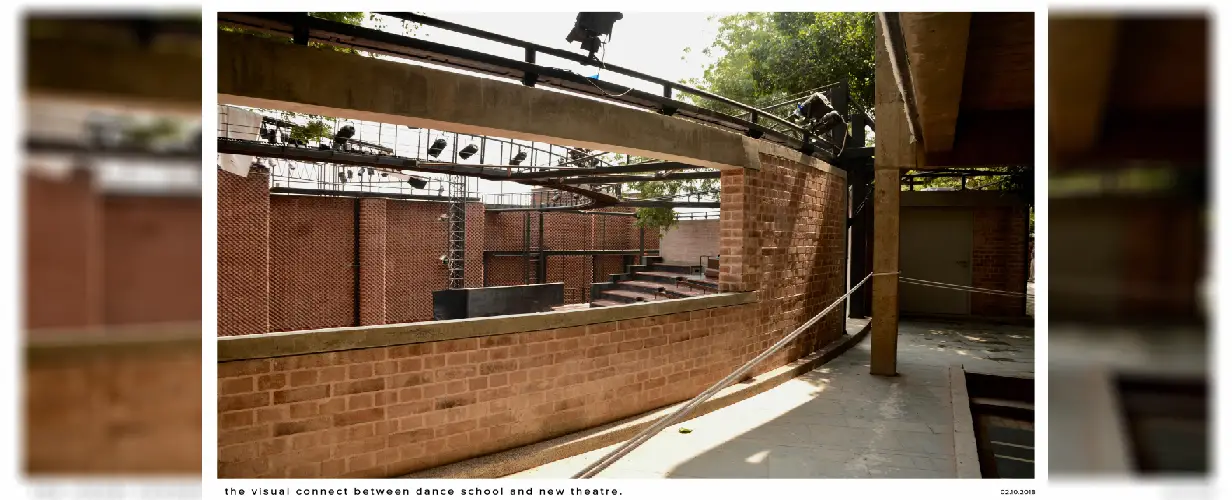
Physical backdrop: The site for the amphitheater is adjacent to the Darpana Academy of Performing Arts dance school built by Achyut Kanvinde in 1962 and in line with several cultural landmarks along the river edge, such as the Mill Owners building by Le Corbusier and the Gandhi Ashram building further along the river. The six hundred year old walled city is seen across from the river on the opposite bank. The site is primarily accessible from a neighborhood street to the west and provides a visual link to the river on the east suggesting a physical link down to the river to establish a vital cultural connect. The Sabarmati riverfront development project in Ahmedabad impacted the existing Natarani theatre precinct. A major chunk of the stage area was lost to the riverfront road and its sidewalk, rendering the theatre
inoperable for several years. It is in the context of this reality that its re-imagination was both imperative and desired for its activities to flourish. The new proposed layout not only attempts to mitigate this situation but also improves upon its existing infrastructure, capacity and reestablishes its centrality in the cultural life of the city.
Program & client brief: A state of the art amphitheater, accessible green rooms, public toilets, mechanical service spaces, improved sound and lighting capabilities with a metal catwalk that floats over the seating, were the main programmatic components of the project. A mandate from our client to use every possible strategy to be sustainable and economical helped anchor the project.
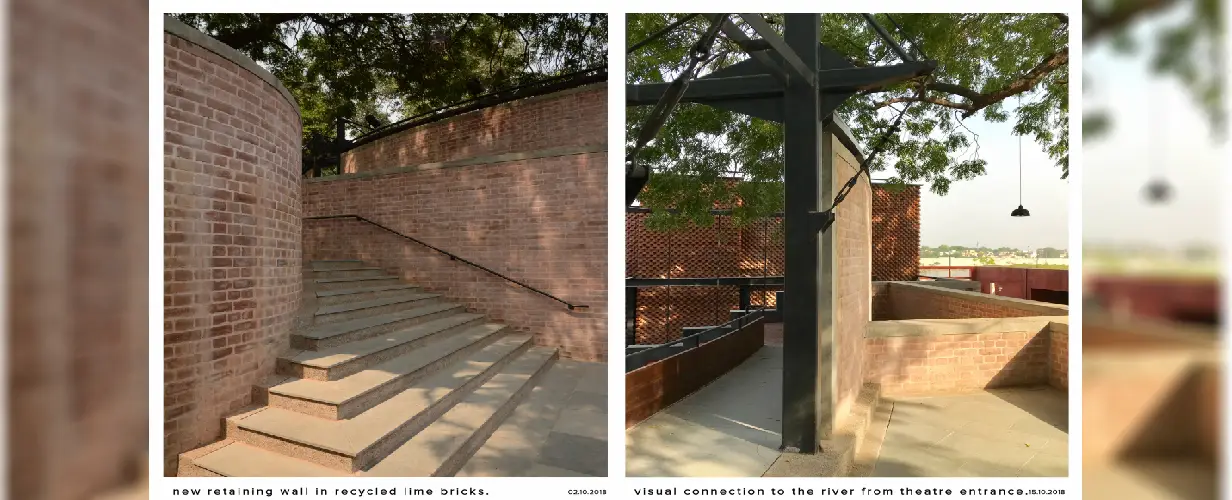
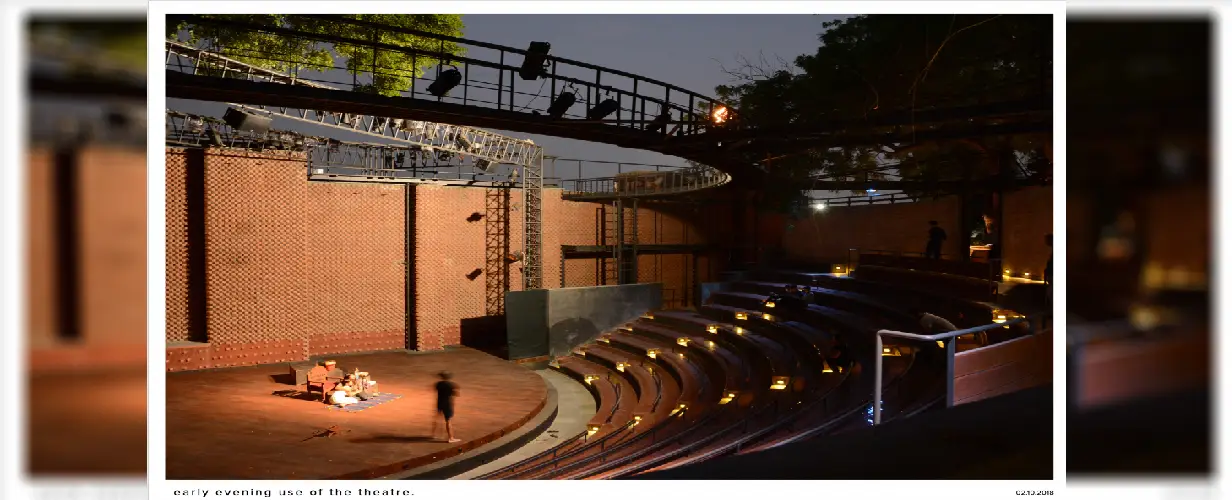
Architectural response: Rebuilding of the new performance space was on the site of the older amphitheater, built in 1994. Critical to our intervention was the adjacency of the existing brick acoustic wall to the river edge, and the modernist Darpana dance school building by Ar. Achyut Kanvinde. The project mandated a meaningful negotiation of these structures and a 4 m contour drop, stepping down from the Dance school to the river sidewalk, integrating the functionalities of the amphitheater as a dynamic spatial experience. The performance space is conceptualized as a ‘well’, on axis with the dance school. Acoustical balance is achieved by architectural manipulation, cupping space within the sweeping exposed brick wall, the seating tiers and the existing acoustical backdrop to the stage. Memories of the past
are retold here, making reference to the existing ensemble of buildings, walls and old trees to create a renewed sense of place.
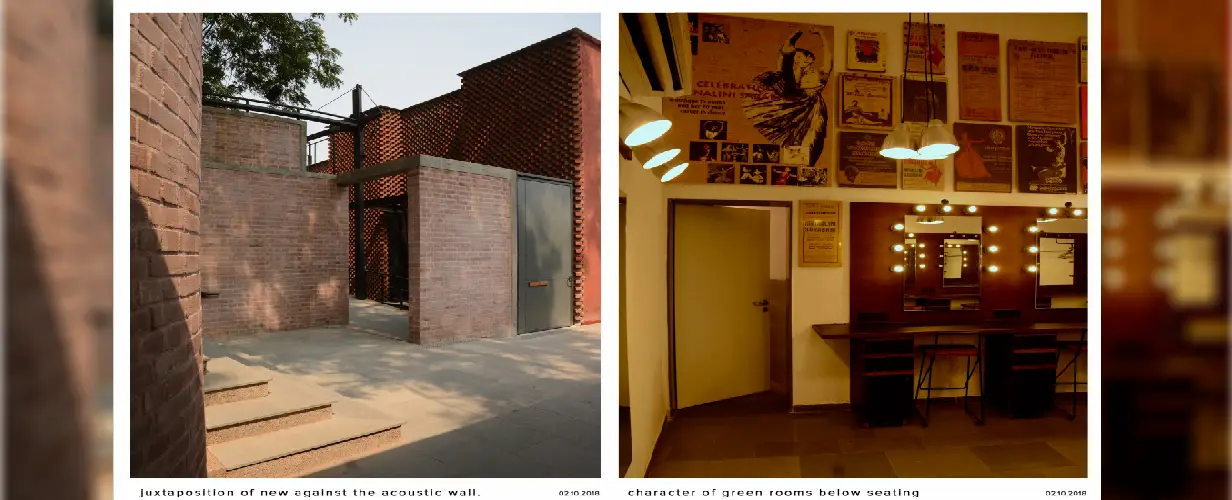
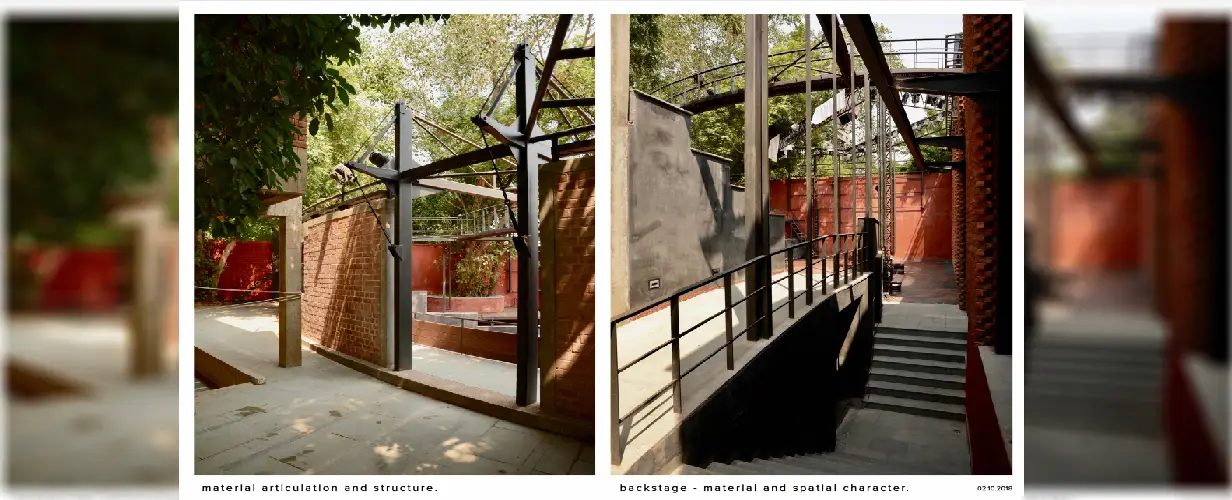
Project details: The proximity of the existing modern era building inspired the warp and weft of the new theatre. Seeking continuity, thearticulation of elements in exposed concrete, steel and lime brick masonry negotiated the edges of the old. The natural contour provided the necessary depth below the concrete cascading tiers to house the green rooms and utilities including the infrastructure for air circulation and cooling. The cross section of the tiered theatre culminates at the stage with its huge water harvesting tank below and the towering scale of the acoustical wall as its backdrop. Backstage assess from the riverfront affords movement for services as well as universal accessibility, seating and the public restrooms. The volumes of the services are tucked into the earth to create a contiguous space adjacent to the plaza as
a roof top garden overlooking the river.
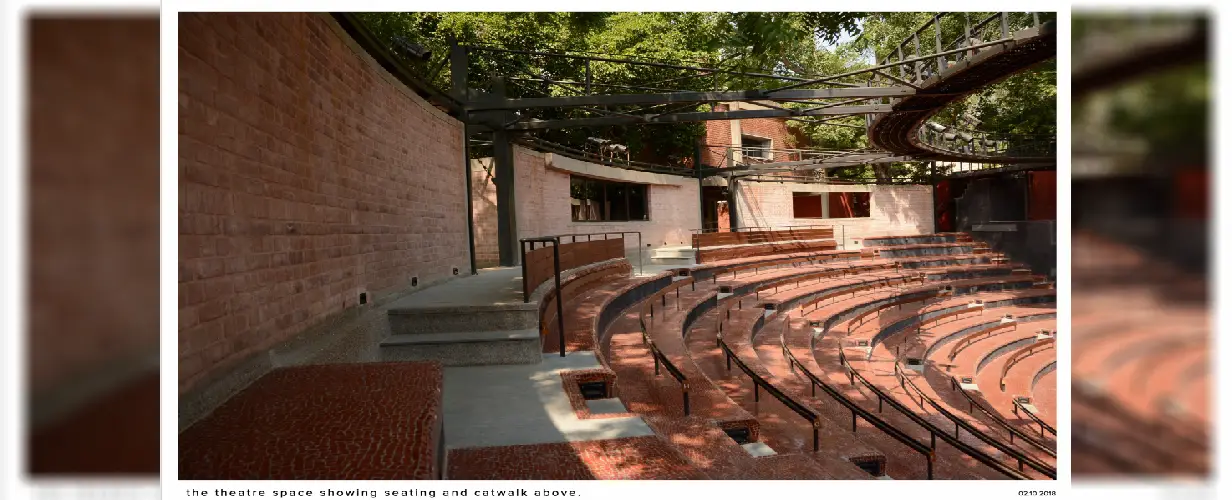
Juxtaposed with the solidity of the brick mass around is the curved cantilevered me catwalk. The catwalk hovers lightly over the seating and is a vital entity that provides efficient accessible mounting for lighting, sound and projection equipment. Its structure comprises a cantilever composed of a system of vertical supports and tension ties that prevent deflection, while compression struts minimize vibrations to maintain a shake free lighting system. The catwalk is radial and stiffened by its railing structure, which acts like a truss transferring forces in direct action. Its corners are braced making it stiff in the horizontal plane, making it an economical and efficient assembly. Composed of square hollow sections, plates, pipes and steel cables, the gesture signifies an important shift towards addressing the language of infrastructure as an expressive engagement with its context. The use of confined masonry and composite R.C.C elements achieves structural stability for seismic zone 4 code provisions, ease of construction and long-term resilience.
Materiality: The earthy seating tiers, covered using traditional china mosaic is expressive and resilient. The dark charcoal and terracotta of the lime-plastered walls compliments the grey of the exposed concrete copings and rough pebble crete in high wear thresholds. The stage is built with a hard wood assembly flooring, while rough grey stone slabs define the entrance plaza that unites the semi-open and open areas of adjacent buildings, thus completing the material palette. All metalwork is painted charcoal black, which essentially gets negated at night, during performances. The physicality and scale of the theatre reverses dramatically at night with enhanced lighting and a sharp central spatial focus.
Sustainable design strategies are at the core of the architectural gestures to define an expressive resilient character. This approach underscores the fact that it is imperative to address issues of thermal comfort and resilience seen as integral to the thought process of design and not a mere overlay. Its salient features include,
1: Use of emissive and resilient materials: All debris from site and adjacent old structures was reused to make new lime – surkhi (brick dust) stabilized bricks.
2: Use of lime mortar an plaster in masonry construction along with dolomite plaster inside spaces to provide the necessary thermal advantage and resilience.
3: Shielding from heat: Since this facility is open to sky, preventing the structure from gaining heat was an important design objective and all services and green rooms were located below the theater steps using the comfortable hollow of the space.
4: Thermal draining of structure: Using rain water to keep the structure cool. A massive, cylindrical brick capsule located below the stage is the rainwater-harvesting tank with a capacity of 1.0 lac liters. It collects all the water from the tiered steps to become a cool thermal storage mass below ground. A low head pump pushes this water to a high level where it is cooled by a radiator through an evaporative process, which consumes very little energy. The cooled water then comes down by gravity through radiant pipes located under the seating tiers and empties into the tank. In this process, it absorbs solar heat from the entire structure, and keeps it cool and maintains the structure temperature below
human skin temperature. The exposed seating becomes comfortable to sit on, maintaining a comfortable ambient level.
5: Displacement ventilation: While the structure loses its heat due to cooling of the structure, a fresh air ventilation system runs in conjunction with structure cooling, to provide a gentle flow of cool (as it absorbs the temperature of the structure) filtered air from several small outlets distributed along the seating tiers under the seats. An air handler situated in the mechanical room below the tiers, sucks fresh air from outside and gently pushes air into the theatre space. This forms a blanket of cool air in the seating zone thereby displacing the warm stale air. It improves the microclimate of the immediate space, making it comfortable for summer evening performances extending into the night.
Capacity and use: The theatre seats 385 persons including 4 stations for wheel chair access. Most performances begin at 8 pm. The experience of the theatre in the night dramatizes the performance space where the stage, the backdrop and the gaze of the patrons come into a sharp direct relationship, melting the metal and ensemble of the infrastructure into the darkness under an open sky. The days quiet and begin late. This time is used by artists to familiarize them to the space and imagine their act as they set up their events and rehearse. In the meantime, the sun invades the space enlivening the surfaces and elements to make this space, re-appear in a new light.
Broad significance of the construction process: The making of Natarani engaged several skilled lime masons who trained others during construction. Masons demonstrating a dying craft of making, brick masonry cylindrical capsule modules for harvesting water, built the rainwater tank capsule below the stage using a practice prevalent in Saurashtra, Gujarat. A team of dedicated lime masons assisted in its making along with a young batch of masons learning the craft.
It gave prominence to the use of pre- bagged lime mortar mixes being used in masonry construction by inducting the services of a new local startup that used recycled brick waste from the city dump and the site to prepare mortar and plaster mixes along with lime. Local carpenters and metal fabricators executed a complex catwalk structure through a very tenacious process of engagement with the design team on site. Universal accessibility norms were followed to access the stage, seating and restrooms for differently abled as a very important design consideration.
Post occupancy readings: Having attended several performances at the venue since it opened, It was gratifying to overhear favorable comments about its character, ambience, thermal comfort and acoustics. The footfalls have improved due to its improved comfort and quality of performances. It has attracted several important national and international theatre and music personalities who have expressed great satisfaction at the quality of experience performing in this venue. The intimacies of connect between the performer and the audience is maintained despite its large open scale. The thermal performance of the space validates the choices of simple technologies deployed for the first time in such a setting with great success.


