
Ar. Sidhartha Talwar, New Delhi
Winners of Architect of the Year Award - Indian Architecture Awards (IAA)
-
Project Name:
Krushi Bhawan
-
Year of Commencement:
2013
-
Year of Completions:
2018
-
Name of Firm:
-
Location:
Bhubaneswar
-
Size:
12077.4 Sq. m
-
Project type:
Public Building

Project Description
Krushi Bhawan is a facility developed for Government of Odisha’s Department of Agriculture & Farmers’ Empowerment. It was originally planned as a purely administrative building; upon our suggestion, the spatial programme was revised to accommodate spaces for community engagement and learning.
The ground floor has been designed as a free-flowing public space that opens out into a plaza, whereas the terrace has been designed to house urban farming exhibits and for demonstration of best agricultural practices. The purely administrative spaces—which have restricted access—have been placed on the first, second and third floors.
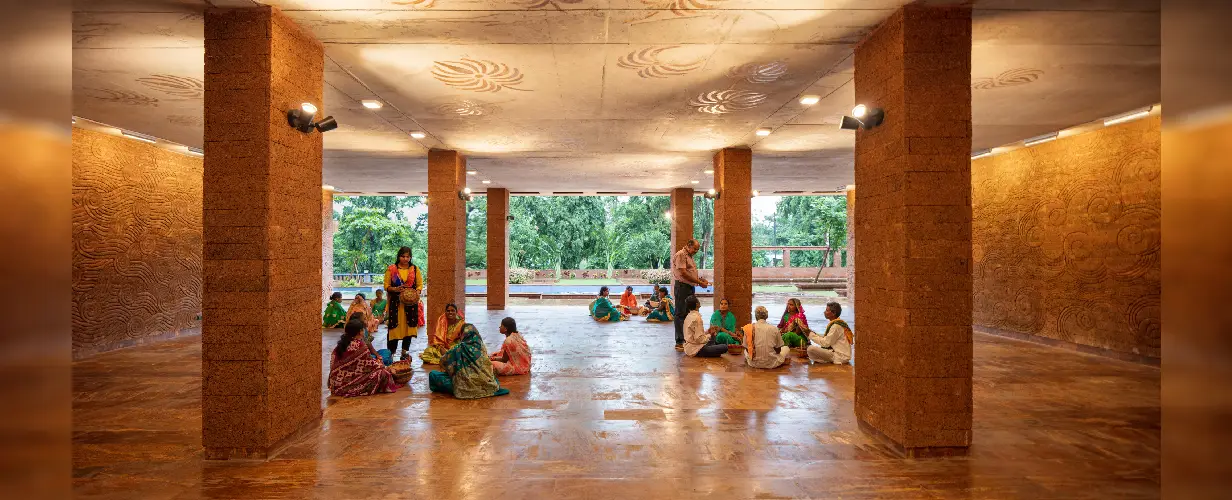
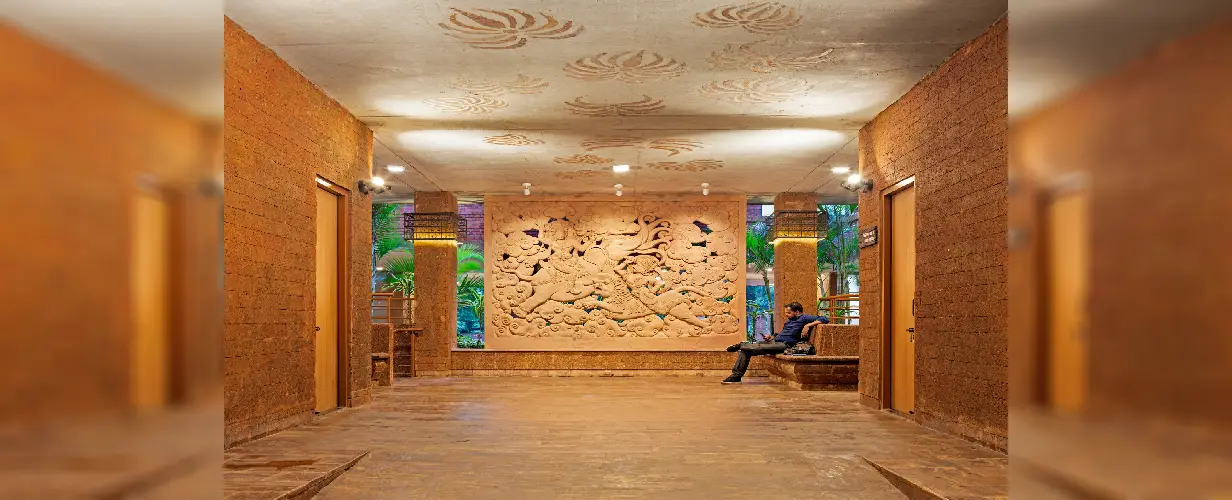
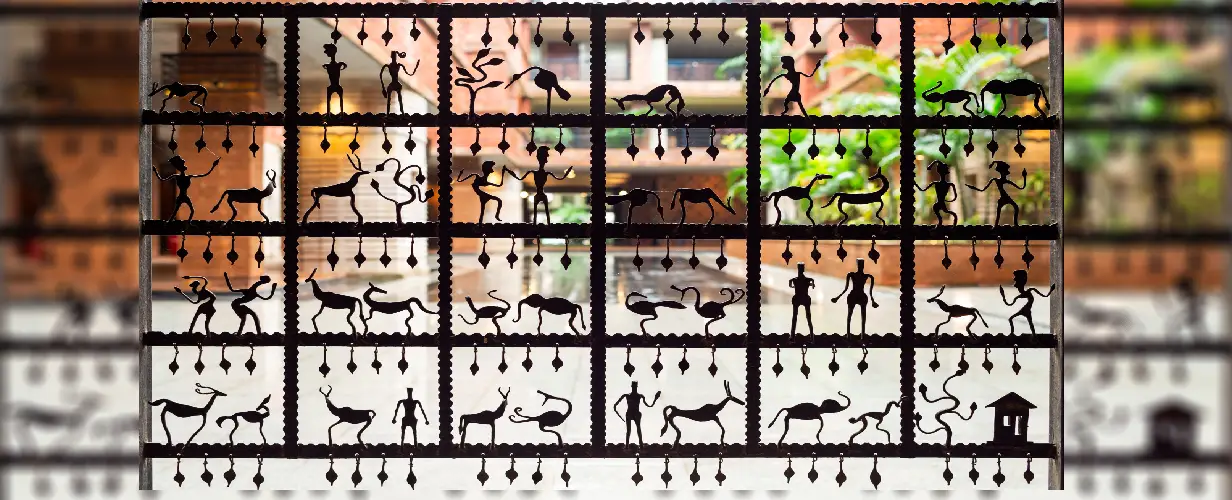
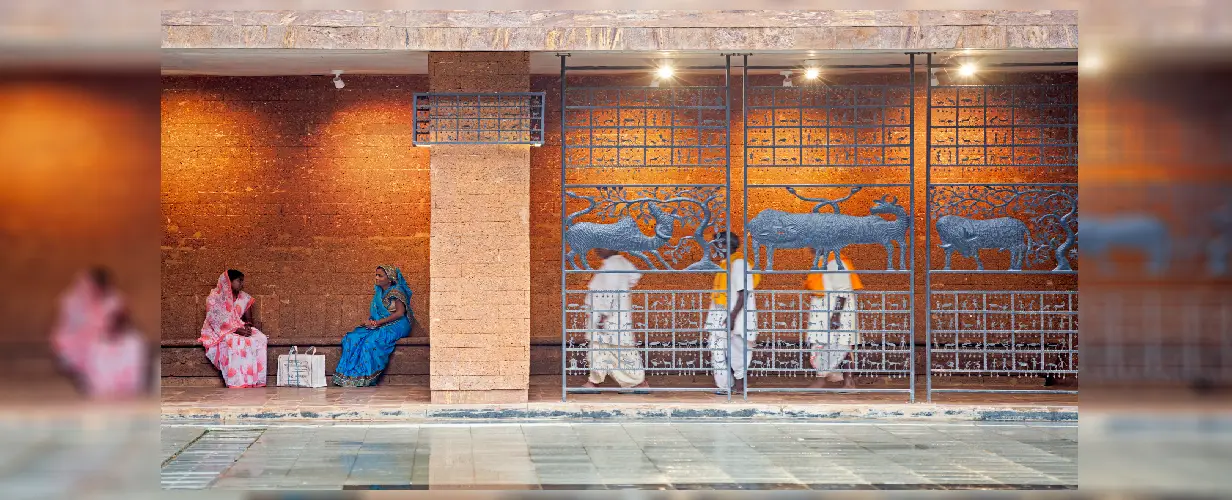
We collaborated with over 100 highly-skilled artisans to create a vibrant and contemporary narrative of traditional Odia craft depicting agricultural folklore and mythological stories, envisioned at an unprecedented architectural scale. The material palette employs locally-sourced laterite and khondalite stones. Dhokra (tribal cast metal craft) has been adapted to make light fixtures and metal screens that line the corridors. Bas-relief carvings in laterite along the Public Plaza depict ripe paddy crops illustrated in the Odia Pattachitra (cloth-based scroll paintings) style.
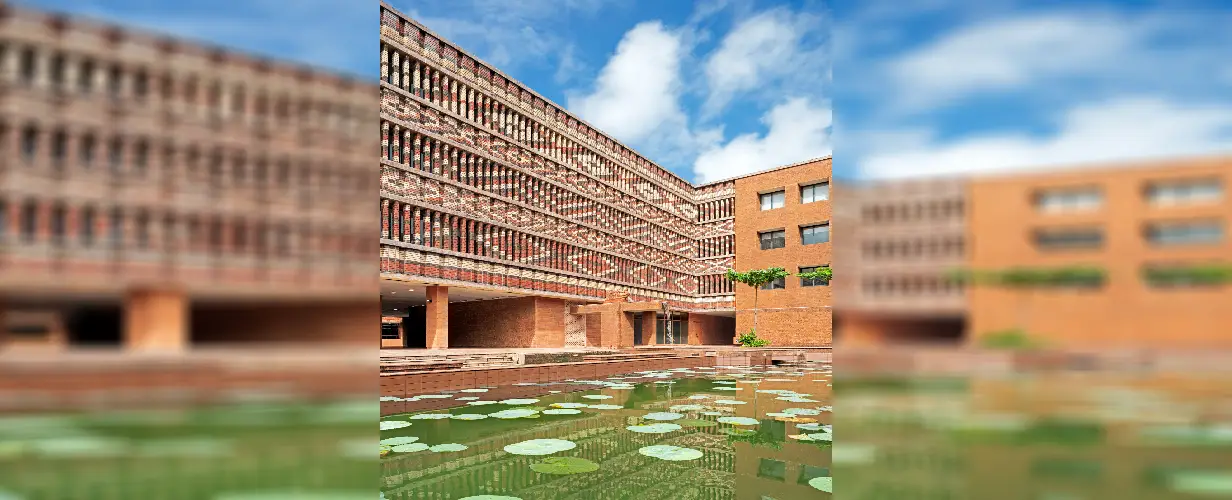
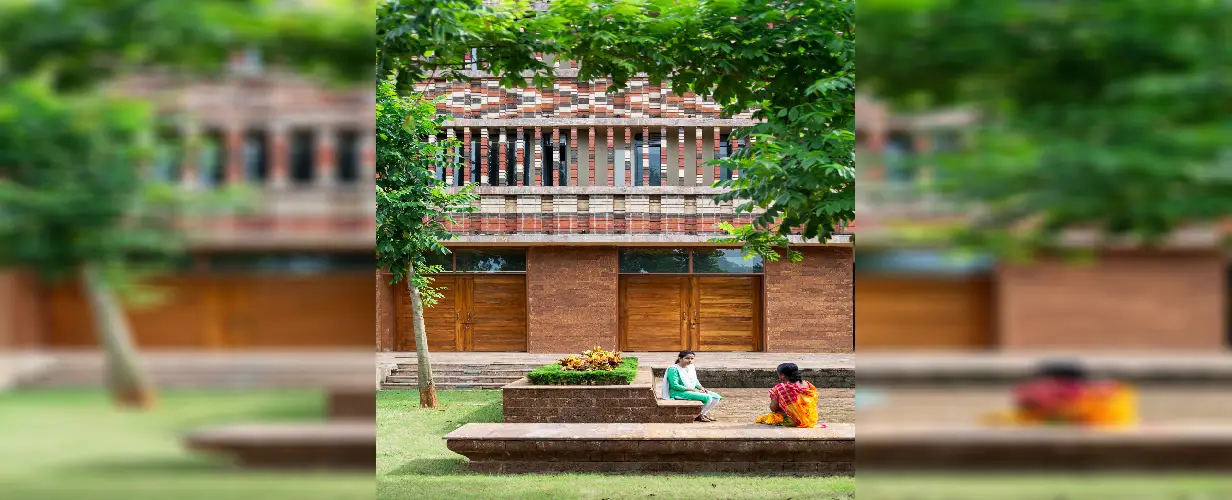
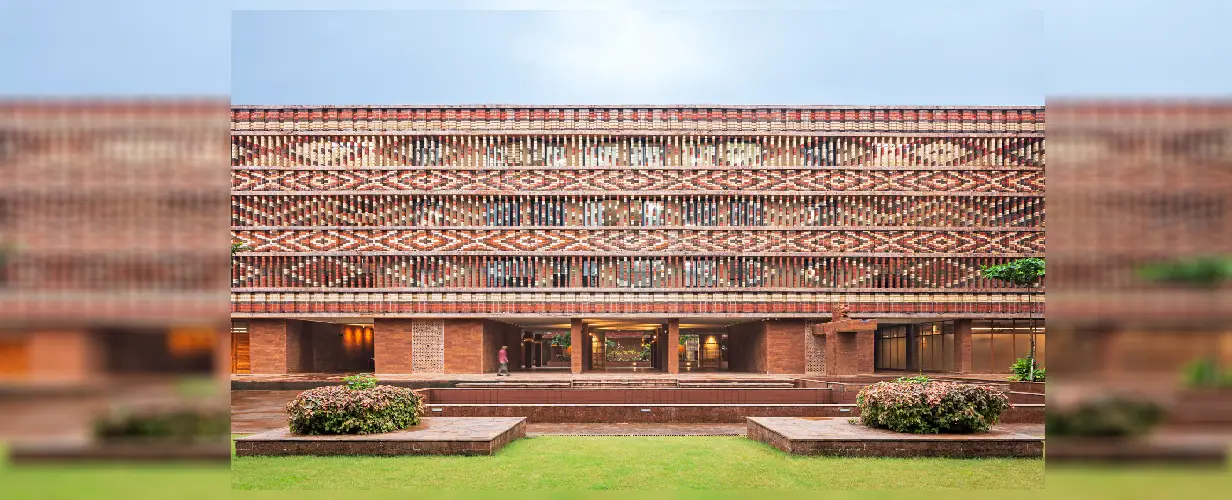
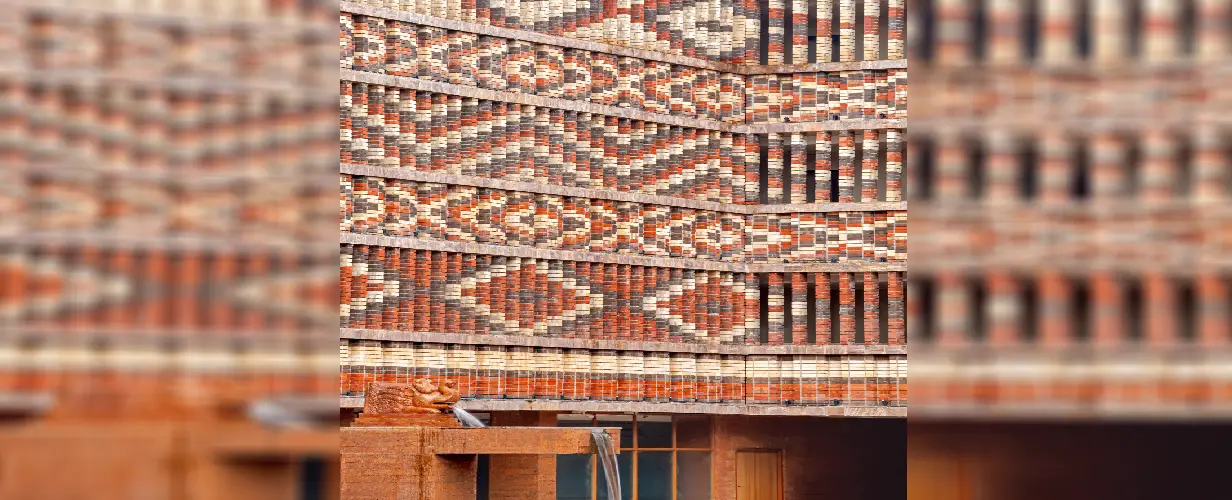
The upper floors feature a distinctive brick façade inspired by Ikat patterns of Odisha handlooms, created using clay in three different colours that represent the region’s geographical diversity. The consequent double-skin fenestration system reduces heat gain to 40% by regulating ingress of sunlight.
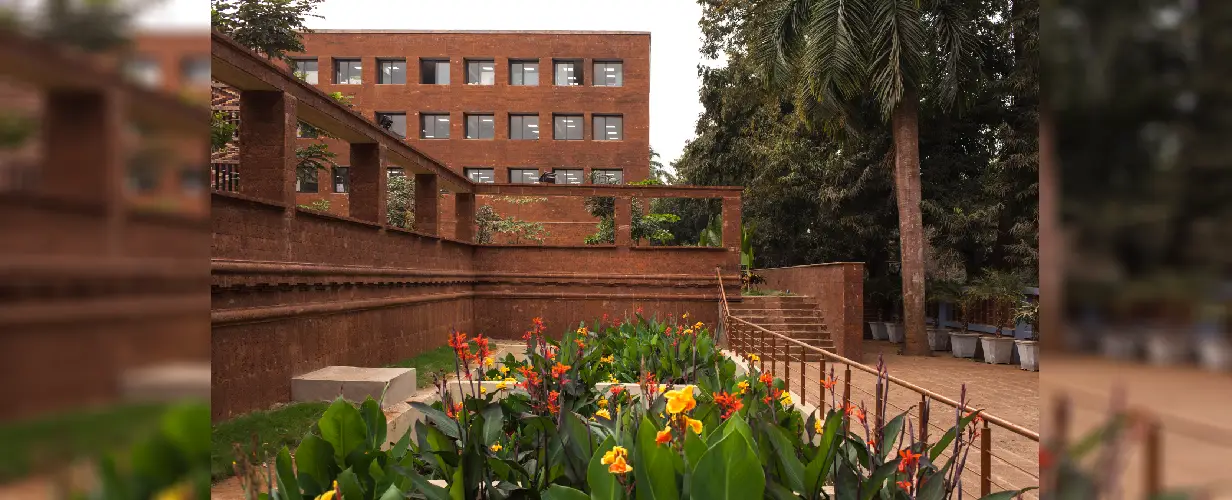
The complex consists of a central courtyard that provides optimal air circulation. It opens through a series of colonnades into the Public Plaza, which consists of a garden with native flora, featuring an informal amphitheatre and a pond that cools the forecourt.
In response to Bhubaneswar’s warm-humid climate, the design integrates passive and low-tech climate control mechanisms, cutting down the need for mechanical air-conditioning to only 20% of the built spaces. Low window-to-wall ratio, deep and staggered recesses also reduce heat gain. A simple night-purging system pulls cool air into the building through the northern façade when temperatures drop at night; the building’s high thermal mass traps this ‘coolth’ and becomes a ‘coolth’ exchanger with the surrounding air in the day when outside temperatures are higher. Other interventions include roof-mounted solar panels, on-site rainwater harvesting and wastewater treatment, and an anaerobic bio-digestive solid waste management system which generates compost and fertigation water for the landscape.
Materials of Construction Details
At Krushi Bhawan, highly-skilled artisans have enabled the creation of a vibrant and contemporary narrative of traditional Odia craft. Dhokra (tribal cast metal craft) has been adapted to make light fixtures and metal screens that line the building corridors. The pedestal level and South Wing use locally-sourced laterite and khondalite stone. Hand-carved khondalite lattices provide a sense of enclosure to the Central Court. Agricultural motifs have been displayed across the building through a variety of craft techniques – such as the bas-relief carvings in laterite along the Public Plaza, which depict ripe paddy crops illustrated in the Odia Pattachitra (cloth-based scroll paintings) style. The Central Court houses a Crop Calendar, created on a stone inlay floor, which displays the harvesting cycles for the most prevalent crops in Odia farmlands.
Inspired by the Ikat patterns of Odisha handlooms, the louvered brick facade has been created using clay in three different colours to represent the geographical diversity of the region, asserting a distinct urban identity. The consequent fenestration system eliminates the need for mechanical air-conditioning in 80% of the indoor spaces.
The strategic integration of craft and technology via a locally sourced material palette. The rich narrative of laterite, khondalite, brass and brick was processed in-situ to lower the environmental impact of the project, and treated to address common concerns like slippage and cleaning—as essential for a public building.
Special Features
(a) Re-imagining the Relationship between the Citizen and the State
Developed for the Department of Agriculture & Farmers’ Empowerment, Government of Odisha in the state’s capital city, the project had an undoubted mandate to reimagine the government’s relationship with its people. The original brief—that of a purely administrative facility—was modified by the architects in consultation with the government to include public functions and community spaces so the building would add to the city’s social infrastructure.
The ground floor is a free-flowing public space, housing a learning centre, a gallery, an auditorium, a library, and training rooms. Through exhibitions, workshops, haats (weekly markets), lectures and school visits, this becomes a hub for imparting skills and sharing knowledge. The terrace houses urban farming exhibits and crop samples to educate the local populace on the best agricultural practices. Spaces that require restricted access are placed on other floors.
(b) The State as a Patron for Local Art/Craft Economies
The coming together of over 100 highly-skilled artisans to punctuate the project’s built fabric with Odia craft at an architectural scale exemplifies how a government can be the prime facilitator of patronage for regional craft and local communities. For instance:
The distinctive brick façade is inspired by the Ikat patterns of Odisha handlooms, created using clay in three different colours that represent the geographical diversity of the region.
The tribal cast metal craft of dhokra is adapted to make light fixtures that wrap around the ground floor columns, as well as metal screens that line the building corridors.
2. An Exemplar of Sustainability: Low-Tech Climate Control
The design integrates passive and low-tech climate control mechanisms, for instance:
(i) DGU on all external fenestration with louvers and sill projections that act as shading devices—a system that reduces heat gain to 40% by regulating ingress of sunlight. The time lag achieved for heat transference through the cavity walls is approximately 6-7 hours, which aids thermal comfort.
(ii) Bhubaneswar experiences significant drops in night temperatures through the year. Taking this into consideration, a simple Night-Purging system has been devised for cooling and ventilation. Through this mechanism, cool air gets pulled into the building through the northern façade when temperatures drop at night, by means of a custom designed ‘low-tech’ damper system. The high thermal mass of the building traps the ‘coolth’ and becomes a ‘coolth’ exchanger with the surrounding air in the day, when outside temperatures are higher. A deduction of internal air temperatures by 7-8°C (in comparison to the ambient temperature) has also been achieved through the night-purge system; the cumulative impact of these interventions has been that only 20% of the built spaces now require air-conditioning via HVAC systems.
GREEN BUILDING FEATURES
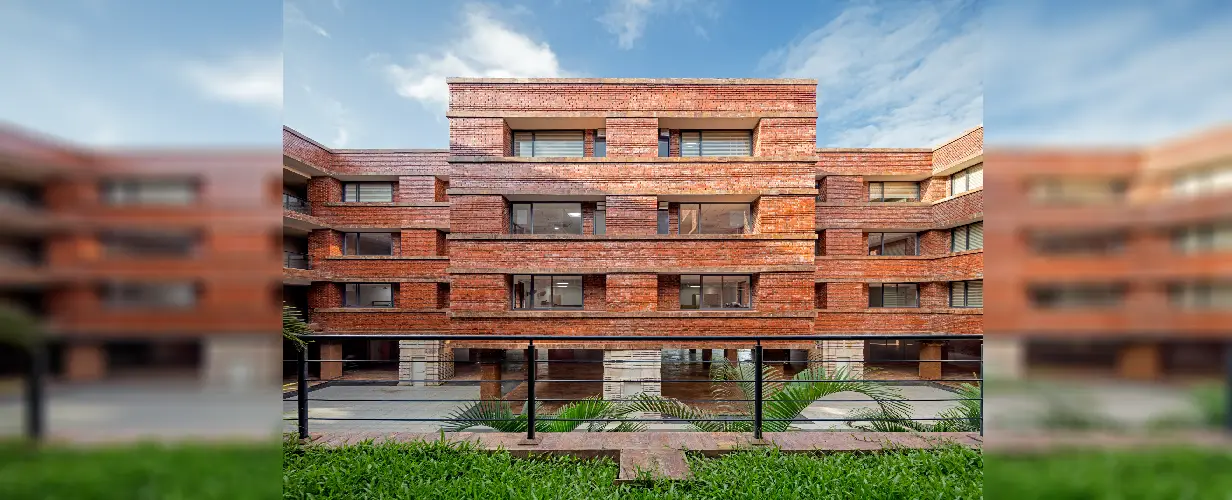
Indigenous passive design strategies contribute to the sustainability parameters of the building. The courtyard morphology and the inclusion of a stilt level aid optimal air circulation through the building, whereas the low window-to-wall ratio and deeply recessed windows and balconies help lower heat gain.
The building profile along the Central Court is characterized by staggered masses which enables self-shading and blocks direct glare.
The project also employs a material palette primarily comprising locally-sourced materials, which has helped in significantly reducing the building’s carbon footprint.
The façade has been designed to ensure 100% daylit internal spaces. Further, a double-skin facade strategy has been put in place at the complex, which consists of DGU on all external fenestration with louvers and sill projections that act as shading devices—a system that reduces heat gain to 40% by regulating ingress of sunlight.
Taking this into consideration Bhubaneswar’s significant drops in night temperatures, a simple Night-Purging system has been devised for cooling and ventilation. Through this mechanism, cool air gets pulled into the building through the northern façade when temperatures drop at night, by means of a custom designed ‘low-tech’ damper system; the high thermal mass of the building traps the ‘coolth’ and becomes a ‘coolth’ exchanger with the surrounding air in the day, when outside temperatures are higher.
The time lag achieved for heat transference through the cavity wall is an optimal 6-7 hours, which aids thermal comfort. A deduction of internal air temperatures by 7-8°C (in comparison to the ambient temperature) has also been achieved through the night-purge system; the cumulative impact of all interventions has been that only 20% of the built spaces now require air-conditioning via HVAC systems.
The project takes the immediate context into account foremost through its site planning, with the building footprint conceptualized keeping in mind the existing trees on site—all of which have been retained and incorporated in the landscaping.
The landscape strategy entails the utilization of local flora in the lawns of the public plaza, as well as the creation of green terraces on the first and second floor of the building; the latter have been incorporated with the interior façade design, with each workspace provided with views of the central court, the terraces, or both.
One-fifth of the floor space at Krushi Bhawan is also dedicated to crop and fishery samples—housed on the terrace level, these urban farming samples serve to train the state’s farmers in the latest agricultural techniques as well as educate the local population about the ecological diversity of the region.
Other interventions include solar panels on the terrace, on-site rainwater harvesting and wastewater treatment, and an anaerobic bio-digestive solid waste management system which generates compost and fertigation water for the landscape.


