
Ar. Suhasini Ayer, Auroville, T.N.
Winners of Green Architecture Award
-
Project Name:
Humanscapes Habitat, Auroville
-
Year of Commencement:
2016
-
Year of Completions:
2018
-
Name of Firm:
-
Location:
Auroville, T.N.
-
Size:
1753 SqMT
-
Project type:
Group Housing

Project Description
Name & Location: Humanscapes Habitat, Auroville, India
Built-up Area : 1753.57 sq.mt
DESCRIPTION OF PROJECT:
The “HUMANSCAPES HABITAT- a project of Sustainable and Integrated Urban Living Project” benchmarking in habitat as a course correction for a sustainable and harmonious mode of development which is an imperative need in present global crisis of energy and climate change. This mixed-use development of residences, community and work space would be a touch stone for standards for low-embodied energy building.
Using local building materials and skills, the residences become a net energy-positive habitat by generating its own energy, using renewable energy. Zero-discharge of water, recycling of solid waste, drought resistant local endemic species landscaping, and growing organic food as a model for urban agriculture would be a hallmark of this project.
Reducing point to point travel by integrating work and living spaces, using integrated community and IT infrastructure (ICITI), and using clean mobility options like e- vehicles for external contact will be a natural consequence of the campus set-up.
The habitat project has integrated four goals as part of the sustainable human settlement program of development;
Sustainable built environment to have building envelopes that are solar passive to be climatically suitable built with efficient space usage and low embodied energy building materials with construction techniques that require minimum processing and machinery.
Integrated environmental planning of water, energy and waste so Zero-discharge of water, recycling of solid waste, water-efficient landscaping using local endemic species, and growing organic food as a model for urban agriculture would be a hallmark of these residences.
The human ecology, using the principles of “Cohousing” concept of housing, facilitating interaction among neighbours for social and practical benefits, economic and environmental benefits. A functional fusion the living, working, recreational and primary amenities allowing a multiplicity of space usage to reduce the built up area to enable the inhabitants to interact actively with the farming and productive landscaping, waste recycling and energy generation as part of the open learning campus
Establish a collaborative network of knowledge resources to facilitate further dissemination called ‘SustaiNet’. A creation of an inter institution network for knowledge sharing and dissemination, offering academics and practitioners opportunities for a learning experience during and after completion of the project.
DESIGN PRINCIPLES (GREEN FEATURES)
Site planning – Site analysis for surface water management and erosion control, protection of top soil and soil permeability during the process of development, retention of natural features, climatic context sensitivity
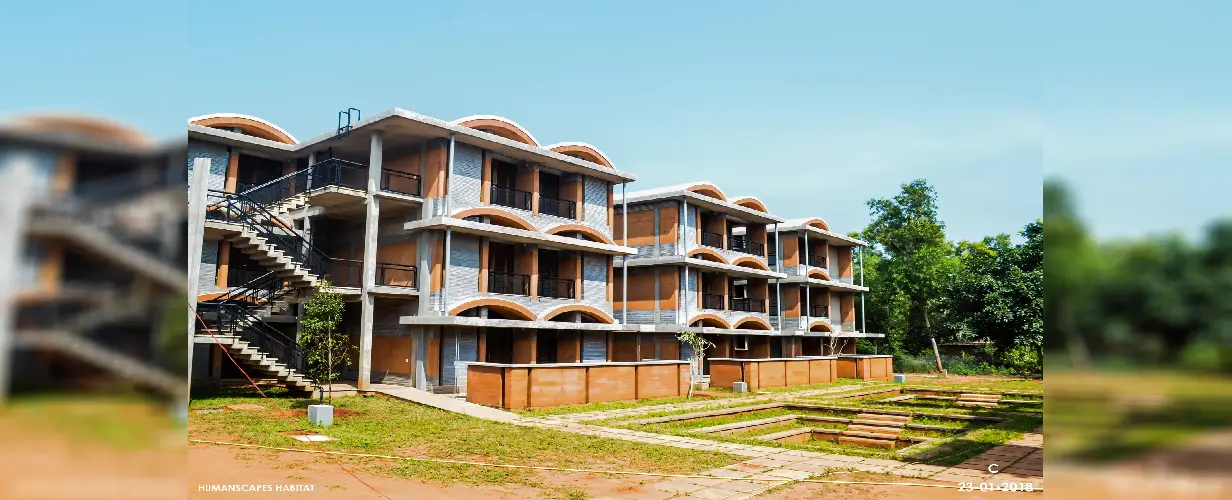
Efficiency of land use – to minimize the foot print of the building by building ground + 2, this allows for walk-up residential units while allowing easy access to the landscaped spaces. Environmentally suitable landscaping with mix of urban agriculture and geo-climatically suitable flora.
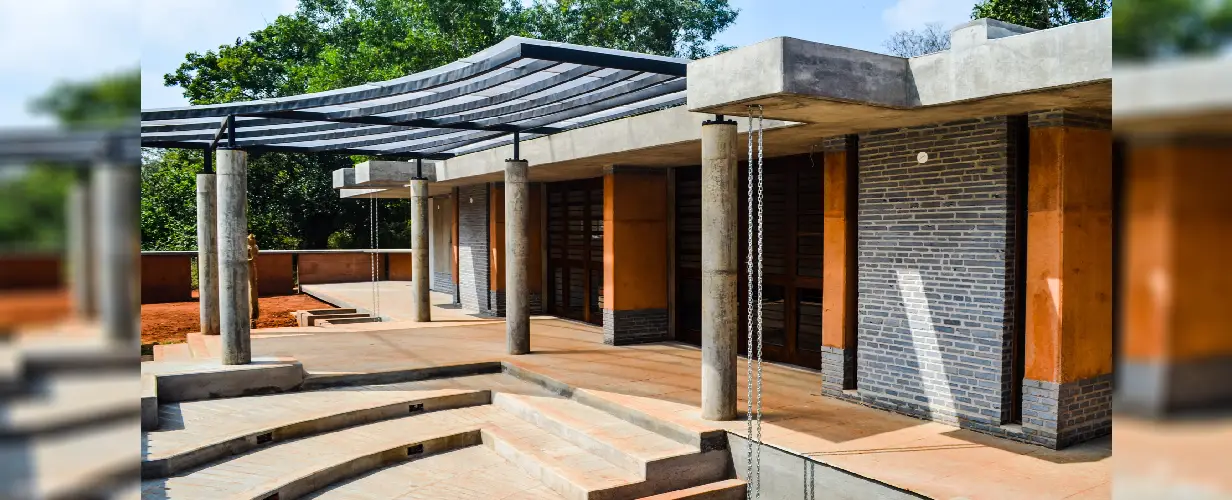
Open space planning – The buildings are grouped around a landscaped court to improve the climatic comfort of the outdoor environment. The landscaped spaces are a mix of urban agriculture producing food for local consumption and regenerative plantation, addressing the ecosystem services sustainability. The landscape integrates passive services like biological sewage treatment area, water harvesting structures, bio-swales etc. All softscapes (planting of trees, shrubs, ground cover) uses wherever possible indigenous species and no white or potable water is used for irrigation (net zero over the year). By managing the mix of species, irrigation demand to be reduced to less than 5 l/sqm of average water demand per day as the project is in a water scarce zone.
The buildings are designed to vent hot air during day time and allow cooling in the evening. The large overhanging roofs have roof level vents to flush out the heat by being combined with openings at floor level to induce cool air entry.
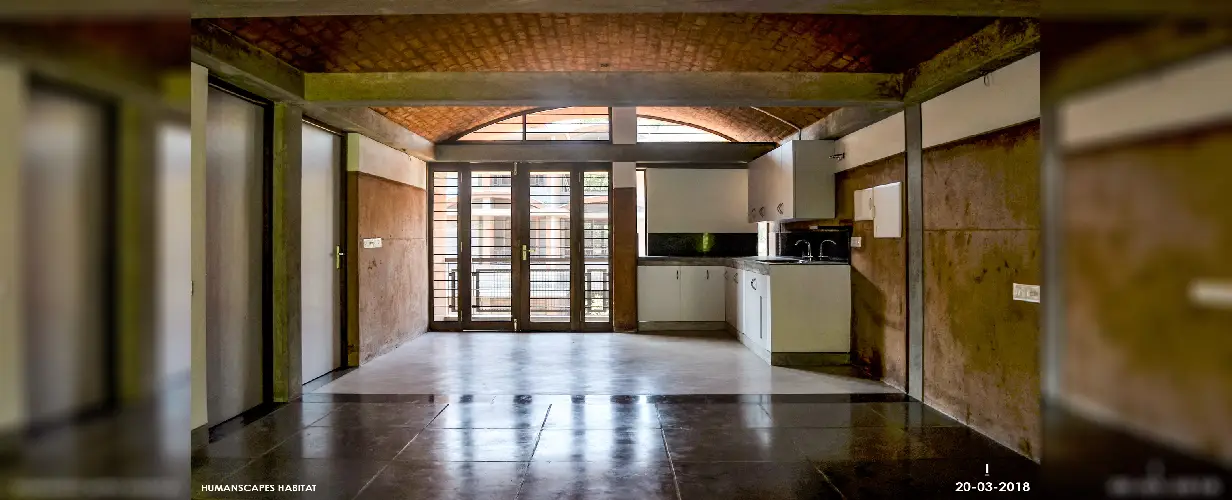
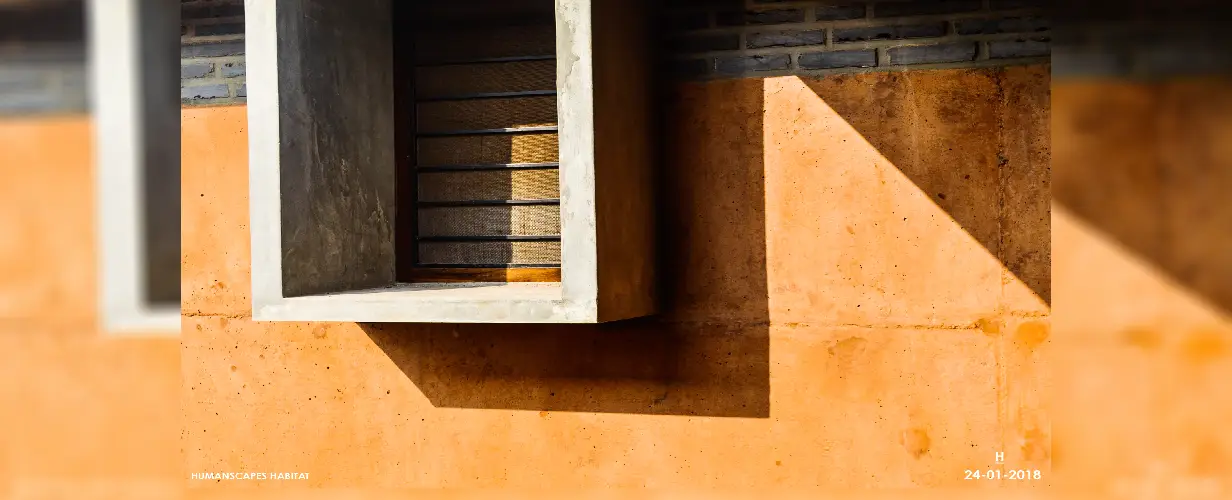
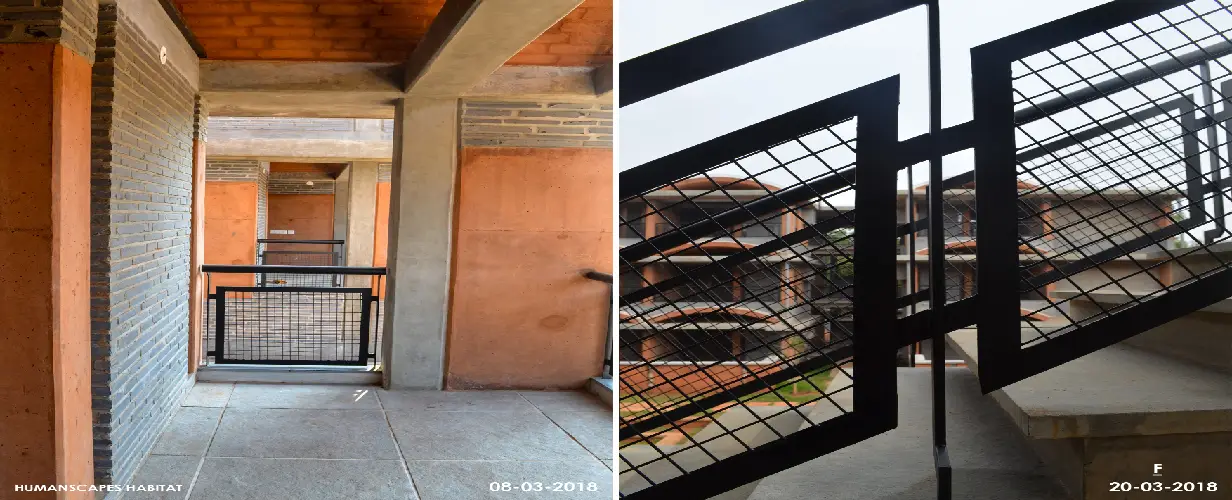
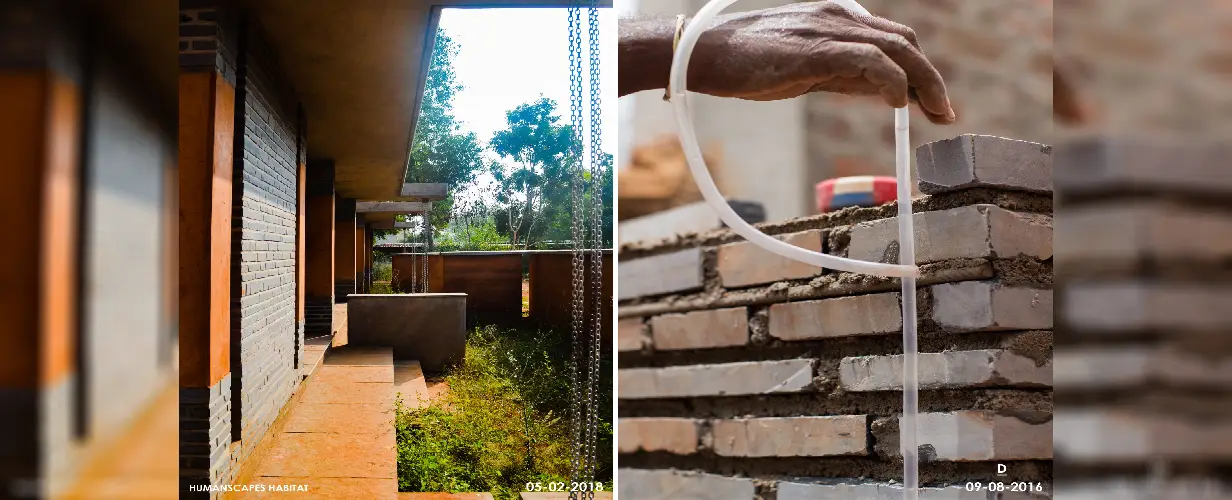
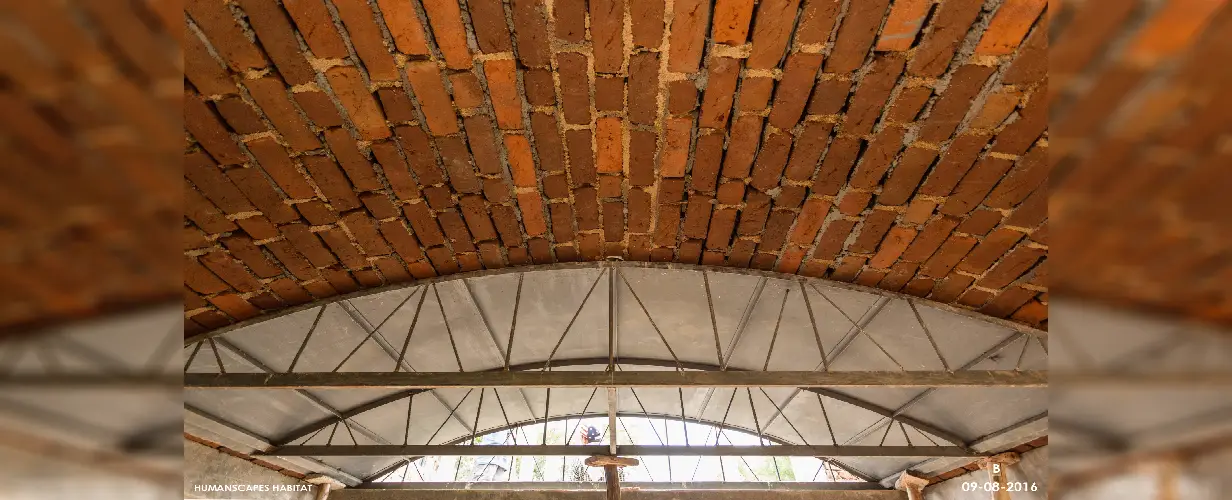
Materials of Construction Details – The building was designed to ensure that the structure use of low steel concrete structures by adopting segmental arch vaults in bricks as roofing with walling in Poured Earth Concrete (PEC) and recycled cuddapha. The excavated land on site are formed into bio-swales as the rain water harvesting structures, reducing the embodied energy along with lowering the carbon miles for the earth used in walling. The waste cuddapah stone strips reused in walls, address the issue of landfills caused by the stone factories. Shredded thermocol is used as under the floor filling for insulation.
All the openings have good overhangs in keeping with the climatic need for shading from sun and rain, recycled timber is used for doors and windows. Floors are a combination of natural stone from the local area and “ IPS” cement floors, a local technique of stucco with colored oxides and marble dust.
Pedestrian and cyclist network – provided an inter-connected network for pedestrians and bicycles with lanes along natural drainage and slope areas. Pedestrian routes are shaded with avenue trees of indigenous shade-providing species interspersed with hard landscaping, comprising of benches, street lighting and accessible curbs for the physically challenged and tactile paving for the visually challenged.
Energy plan and systems – To achieve a “net zero energy use” the project is designed and functions with a solar grid connected system. The PV panels also feed a system of energy storage batteries that provide for emergency backup and lighting of public spaces including the street lights. The apartments have all been design to have an efficient wiring system coupled with energy efficient lighting and appliances.
Sewage treatment system using Decentralised Effluent Treatment plants – The sewage water is treated in a Decentralised Effluent Treatment Plant or Plants (DEWATS) which is connected at the lowest elevation area to allow for maximum gravity flow and to reduce the dependency on electrical pumps. Treated effluent is supplied for irrigation and other non-potable use by gravity flow after the treated water is pumped up to a higher elevation in the neighbourhood.
Water and waste – The targeted water consumption 45 litres per resident per day (consumption of non-recycled white water for bathing, cleaning, washing, cooking, etc.) without compromising on service quality. If we manage to achieve this, it will represent a three-fold improvement over the earlier National Building Code benchmark of 135 litres per head per day, and nearly half of the current reduced benchmark level of 86 litres per head per day. Conservation of water shall be by extensive use of low flow fixtures.


