
Ar. Shantanu Poredi & Ar. Manisha Agarwal, Mumbai
Winners of Public Building (Commendation Award) - Indian Architecture Awards (IAA)
-
Project Name:
School of Planning & Architecture Vijaywada
-
Year of Commencement:
2012
-
Year of Completions:
2018
-
Name of Firm:
-
Location:
Vijaywada
-
Size:
29200 SqMT
-
Project type:
Public Building

Project Description
Shantanu Poredi is an architect, urbanist, academician and the co-founding partner of MO-OF / Mobile Offices Architects in Mumbai. He studied at the School of Architecture at CEPT, Ahmedabad (1995). After a brief professional training period with Anant Raje, he worked with Architects Combine, Bombay for four years after finishing from Ahmedabad. He further pursued his Masters in Architecture (Urban Design) on a J.N. Tata Scholarship grant during 1997-1998 at the Architectural Association, London. In 1990-2000 he worked as an assistant architect at Terry Farrell and Partners, London.
In 2001, he founded MO-OF along with his partner Manisha Agarwal in Mumbai. He is currently visiting faculty at Kamla Raheja Vidyanidhi Institute of Architecture, Mumbai where he has been teaching since the past 18 years.
He has been invited to lecture and also present the firms work in Amsterdam, Berlin, Shenzhen along with several other cities and towns in India. He has also been invited to speak at Indo German Urban-mela at Bangalore.
His areas of interest and concern are design of offices environments, Healthcare institutions, educational institutions, exhibition design and art collaborations.
MO-OF/ PROFILE
MO-OF/ Mobile Offices is a design practice set up in 2001 in Mumbai which focuses on Architectural, Urban and Interior design. The studio is led by two principal architects Shantanu Poredi( AA, London; C.E.P.T. India) and Manisha Agarwal (Cornell, NY ; C.E.P.T. India).
The firm has completed projects of various program categories such as educational campus, hospitality, residential communities, offices, exhibitions and healthcare. Our project, Shifting Voids: Student Housing at the School of Planning and Architecture, Vijayawada was awarded first place at the XIV International Competition of Architecture and Design “EURASIAN AWARD 2018” in Yekaterinburg, Russia. And the GRIHA award for the SPA-V campus for passive energy design
The firm has also won the ‘Architect of the Year Award’ for a university group housing project in 2010 amongst several other awards. The firm had been invited to design the visitors pavilion at Urbanism and Architecture Biennale at Shenzhen, China in 2013. They have exhibited at the Aedes Gallery in Berlin and have been invited by the NAI and Dutch DFA for workshops and as speakers at conferences in Netherlands.
MO-OF’s interest in architecture and design stems from the debate on the evolving cities and the potential it offers a designer. The engagements with communities, the context the works are situated in, create design frameworks for the architectural rhetoric. The primary issues that the practice engages with are Social, cultural, environmental sustainability – these issues usher explorations that transform building types and typologies.
Ideas are tested through the various competitions the practice engages with at all levels. This has led to an opportunity for realizing some of the largest projects of the practice. The firm has anticipated research areas that have raised curiosity with diverse subjects and ushered the practice towards an unsolicited architectural realm. The belief is that a repository of design knowledge is available to each member of the team working towards growth within the firm’s life cycle. The essence of the practice is embedded in the idea of collaboration with diverse co-creators. The practice has been informed by pedagogy and academic research through a multidisciplinary approach to design and its execution.
Manisha Agarwal is an Architect, urban designer, academician and the founding partner of MO-OF Architects/Mobile Offices in Mumbai. She studied at the School of Architecture at CEPT, Ahmedabad (1996). In 1994 she received a fellowship for the student exchange program at the Bezalel Academy of Arts. Jerusalem, Israel. After a brief professional training period at Reinhold Pingel in Auroville, she worked with Kiran Kapadia Associates, Bombay after finishing from Ahmedabad.
She further pursued her Masters in Architecture (Urban Design) during 1998-2000 at Cornell University, New York where she received several scholarships. In 2000-2001 she worked as a project architect at Rafael Vinoly Architects in New York.
In 2001, she founded MO-OF along with her partner Shantanu Poredi in Mumbai. She is also currently visiting faculty at Kamla Raheja Vidyanidhi Institute of Architecture, Mumbai where she has been teaching since the past 12 years.
Her areas of interest and concern are community housing, educational institutions, hospitality
MO-OF/ Mobile Offices is a design practice set up in 2001 in Mumbai which focuses on Architectural, Urban and Interior design. The studio is led by two principal architects Shantanu Poredi( AA, London; C.E.P.T. India) and Manisha Agarwal (Cornell, NY ; C.E.P.T. India).
The firm has completed projects of various program categories such as educational campus, hospitality, residential communities, offices, exhibitions and healthcare. The firm has also won the ‘Architect of the Year Award’ for a university group housing project in 2010 amongst several other awards. The firm had been invited to design the visitors pavilion at Urbanism and Architecture Biennale at Shenzhen, China in 2013. They have exhibited at the Aedes Gallery in Berlin and have been invited by the NAI and Dutch DFA for workshops and as speakers at conferences in Netherlands.Our project, Shifting Voids: Student Housing at the School of Planning and Architecture, Vijayawada was awarded first place at the XIV International Competition of Architecture and Design “EURASIAN AWARD 2018” in Yekaterinburg, Russia.
MO-OF’s interest in architecture and design stems from the debate on the evolving cities and the potential it offers a designer. The engagements with communities, the context the works are situated in, create design frameworks for the architectural rhetoric. The primary issues that the practice engages with are Social, cultural, environmental sustainability – these issues usher explorations that transform building types and typologies.
Ideas are tested through the various competitions the practice engages with at all levels. This has led to an opportunity for realizing some of the largest projects of the practice. The firm has anticipated research areas that have raised curiosity with diverse subjects and ushered the practice towards an unsolicited architectural realm. The belief is that a repository of design knowledge is available to each member of the team working towards growth within the firm’s life cycle. The essence of the practice is embedded in the idea of collaboration with diverse co-creators. The practice has been informed by pedagogy and academic research through a multidisciplinary approach to design and its execution.
THE INSTITUTE @SCHOOL OF PLANNING AND ARCHITECTURE, VIJAYAWADA, BUILT UP AREA: 29200 SQM
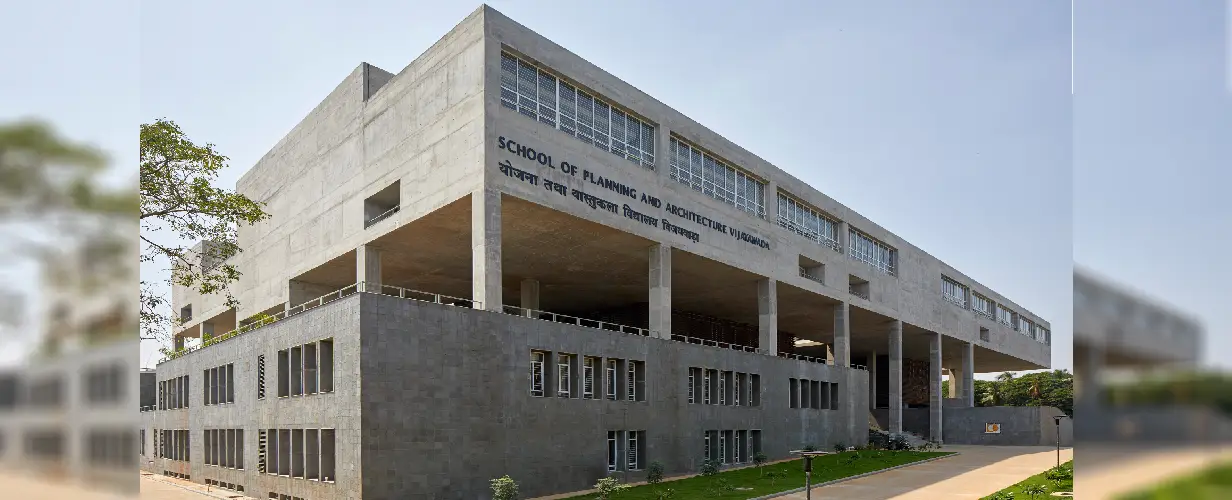
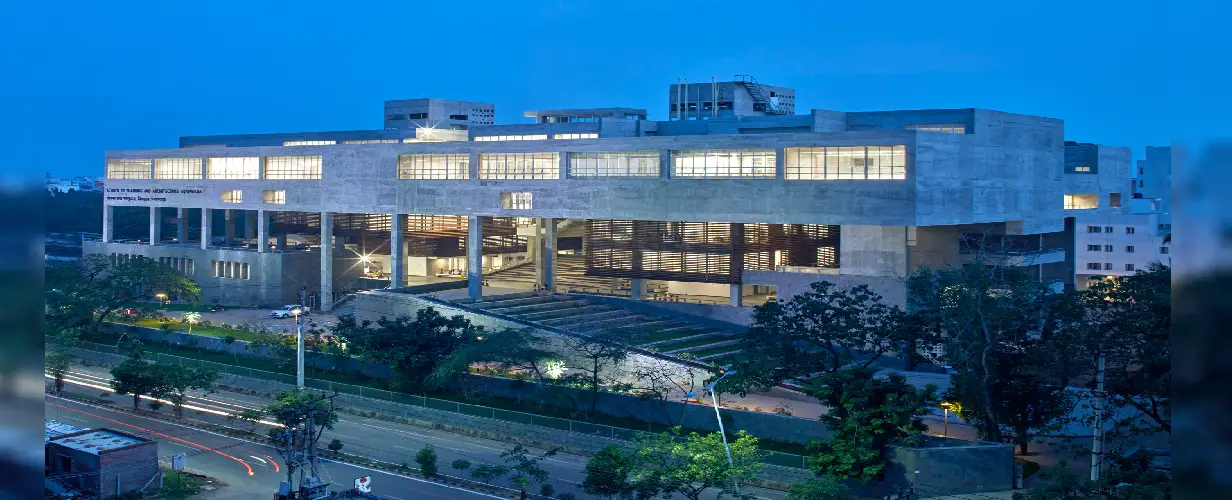
The School of Planning and Architecture, Vijayawada, attempts to make the campus an institutional centre in the city of Vijayawada. The institutional building is a platform for academic debate, exchange and dissemination and becomes a deep gateway and an interface to the entire campus.
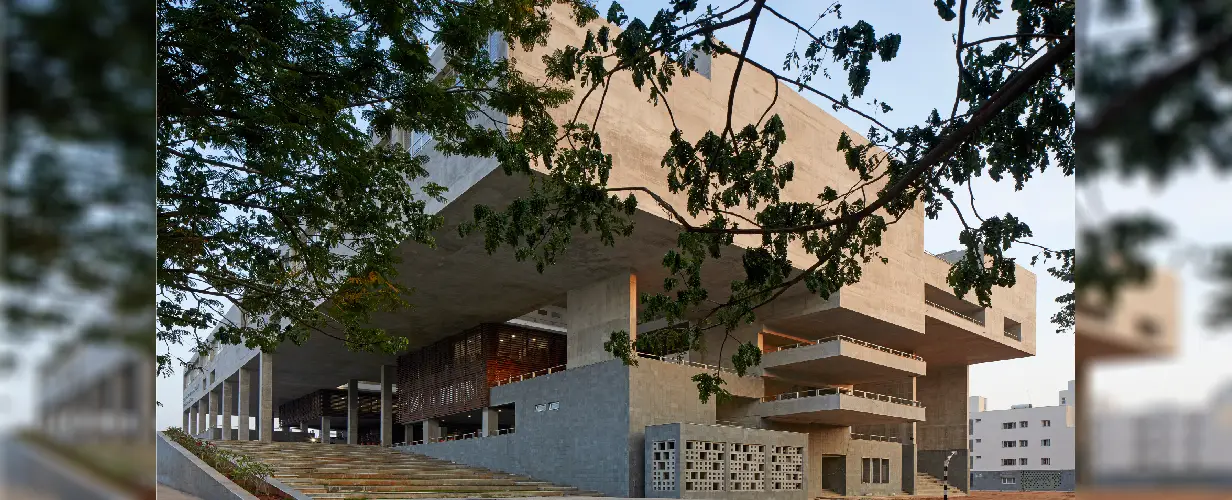
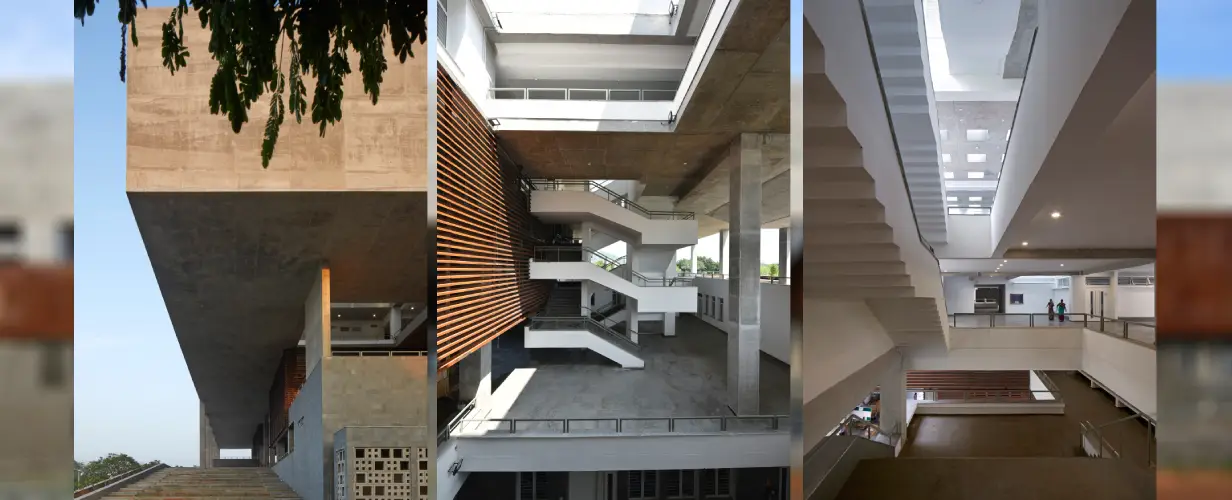
The Institute draws on the austere ideologies from Brutalism as a form of expression as a response to the extreme climate, and positions it contextually in Vijayawada. The design demonstrates a scale akin to a public building on the outside and the inside explores the didactic nature of space by creating a humane scale apt for an engaged student community. The large volume is punctured by voids, creating a rhythmic play of light and shadows which allows the building to respire; thus yielding spatial patterns that perform as a scaling device. The design focuses on the diversity of individuals and the vastness of a community and creates Interdependent programs that offer a multitude of interactive spaces that would be beneficial for a community experience.
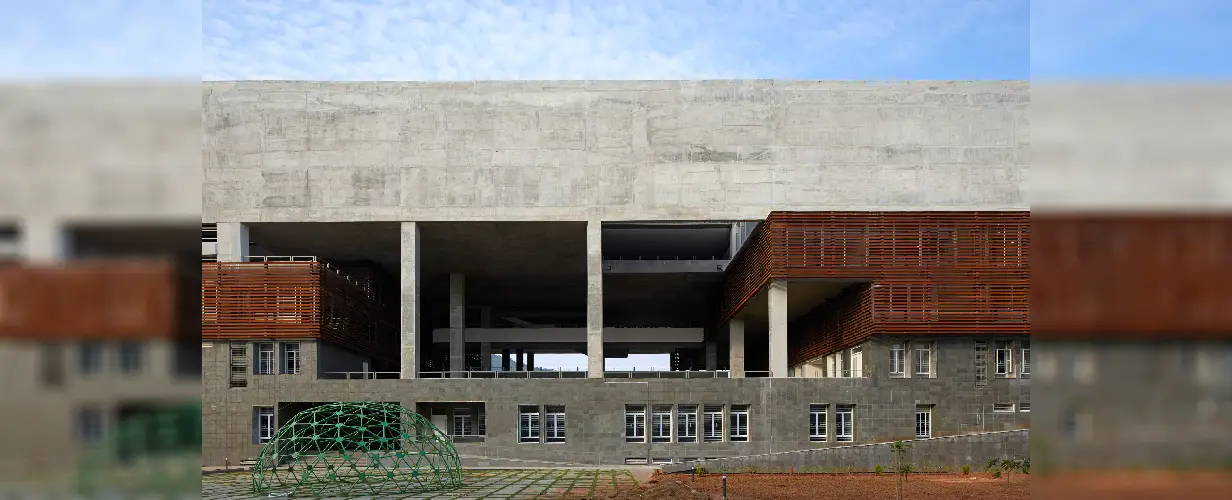
The relationships between three sections -The Parasol, Concourse and the Platform have been structured into a three dimensional constellation that is informed by movement and varying levels of privacy of diverse programs.
PARASOL– The top most section of the building houses the morning programs of the learning curriculum such as classrooms and studios. It also acts as a volumetric parasol roof for the lower floors creating a shaded environment below.
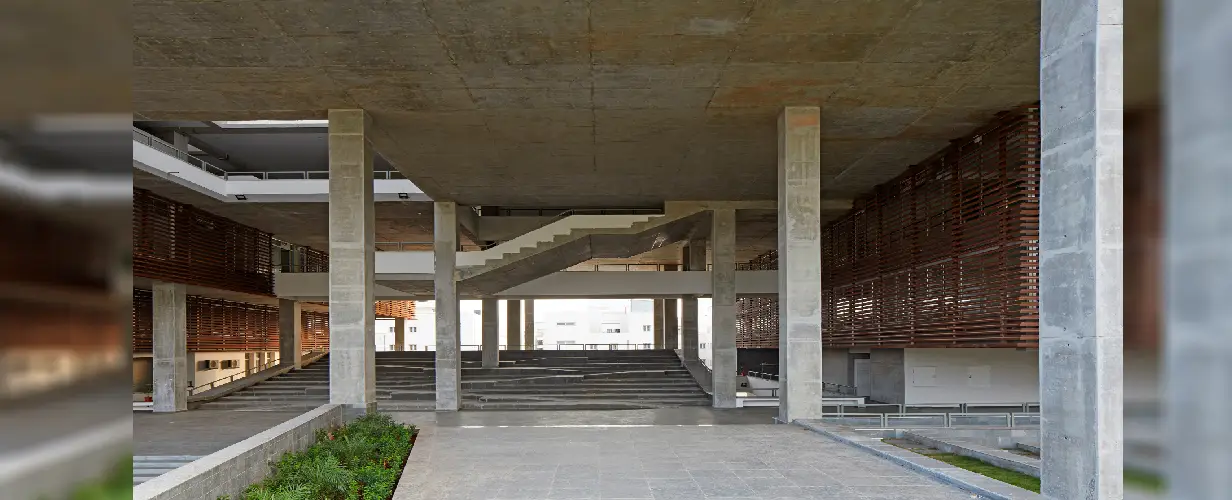
CONCOURSE – The middle section of the building is a ‘Stilted Platform’ that allows for student activity. This zone is a reminder of the traditional courtyard that anchors common public and community programs. It behaves as a concourse to the entire building as it filters and mediates the movement of people. Smaller courtyards work as three dimensional light wells which offer visual connectivity through the layers above and below. This ‘Universal zone’ is occupied by faculty, students, administrators and visitors enabling non programmed exchange.
The PLATFORM-The bottom most section becomes a heavy base to a floating canopy. The base houses the afternoon programs of the learning curriculum such as workshops and Laboratories and is cladded with local Tandur stone which increases the ‘Time Lag’ for solar- heat gain. This solid platform is punctuated with voids that allow for hot air to dissipate.
MATERIALS OF CONSTRUCTION AND DETAILS:
The materials are used in their raw form such as the fair-faced concrete walls on the periphery of the higher floors, local tandur stone in riverwash finish for cladding the base of the building and polished/ riverwashed tandur stone is used for flooring; Corten Steel is used as a louvered screen along with precast jail screens in certain areas. AAC Blocks with 70% fly ash content have been used. Energy consumption has been reduced through efficient lighting, HVAC, appropriate glass etc., solar panels have been provided.
ENVIRONMENTAL SUSTAINIBILITY:
The building demonstrates responsive environmental architectural concerns through passive design strategies for an extreme hot and humid climate of Vijayawada.
Climatically the building harnesses the prevalent winds of the Krishna river basin to create cross ventilation and provide human comfort by convection in this hot and humid region. The courtyards funnel winds through the building and enable cross-ventilation, thus regulating the diurnal temperatures. The multiple voids render the building block porous, allowing the hot air to get extracted from the building, the northlight windows bring in natural light in the studio spaces, the parasol shades the informal spaces below reduces energy usage for a building thus enabling it to be a model of passive energy design of building in harsh climates. The use of rainwater harvesting on terraces, solar energy for lighting, local materials, treating of waste all create a sustainable model of design for an institution of learning.
SOCIAL SUSTAINIABILITY:
The built environment is choreographed as a campus that is open, accessible and democratic in nature, breaking formal barriers between the street and the building envelop so as to bring education closer to the public realm thereby challenging contemporary hermetic organizational structures of educational campuses across the world.
The concourse is connected by multiple amphitheaters and stairs creating a platform for people, thereby making the architecture both interactive, inclusive and socially sustainable. The boundaries of the inner spaces are blurred to initiate conversations across the corridors, double height spaces and through voids. The voids of the building form visual connective networks across departments of architecture and planning schools dissolving the floor wise stratification of the building by spatially connecting programs with stairs in varied configurations across the section of the building.
The building intends to create an interactive community learning environment nestled within its cultural context with a keen focus on environmental sensitivity.


