
Ar. Muhammad Moniruzzman, Dhaka
Winners of Architect of the Year Award - Foreign Countries' Architecture Awards (FCAA)
-
Project Name:
Office Building of Teach for Bangladesh, Dhaka
-
Year of Commencement:
2017
-
Year of Completions:
2017
-
Name of Firm:
-
Location:
Dhaka
-
Size:
1085 SqFT
-
Project type:
Public Building

Project Description
Salient Features of the Project
Name & Location: Teach for Bangladesh House#, 210/A-2 Bir Uttam Mir Shawkat Sarak, Dhaka 1208.
Cost of Project: (US$) 9492.00
Built-up Area: 10853 sft.
Description of Project:
When the founders contemplated “Teach for Bangladesh”, which is part of a Global movement of young leaders working to end educational inequity in Bangladesh, their challenge was: Children are not in control over their destinies; their opportunity to succeed personally, academically and professionally is limited by the socio-economic condition of their families. In fact, tens of millions of children in Bangladesh are denied high-quality education as a result of an inequitable system.
Bringing about meaningful, sustainable changes to develop the status quo for disadvantaged children require leaders, who are rooted in their local culture, challenges and opportunities, and who believe in the potential of children and their communities. TFB takes a two-step approach to address the educational inequity prevalent in the society through reducing educational disparity in targeted schools and communities while simultaneously building a movement of leaders, who will spearhead the macro-level reform needed to reshape our education system and society in the long run.
Studio Dhaka Ltd. was handed the challenge to create a more minimalist yet brighter headquarter for TFB, featuring collaborative open-plan workspace. Also, since TFB is a donor-based welfare organization, there were fund limitations due to the charitable nature of their business. As a consequence, the concept of the project goes completely “against the wind”: A low-lying building constructed by materials of lowest possible cost. Studio Dhaka Ltd. followed a design philosophy that quite resonates with the Bangladeshi design aesthetics, with rooms that are typically light, airy and bright, with modern furnishings and natural materials, especially wood to complete the style of cool, calm and uncluttered working spaces.
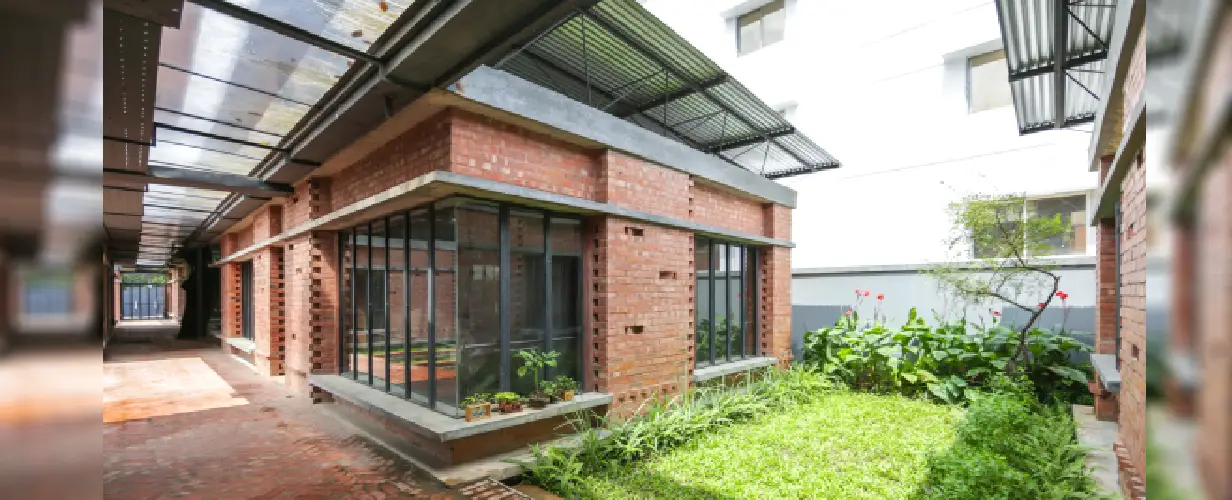
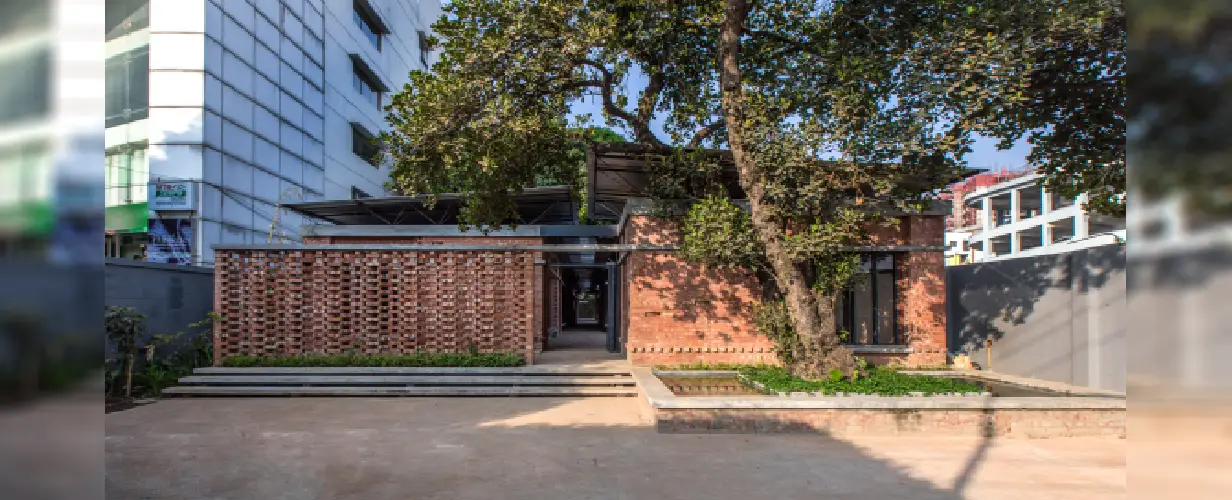
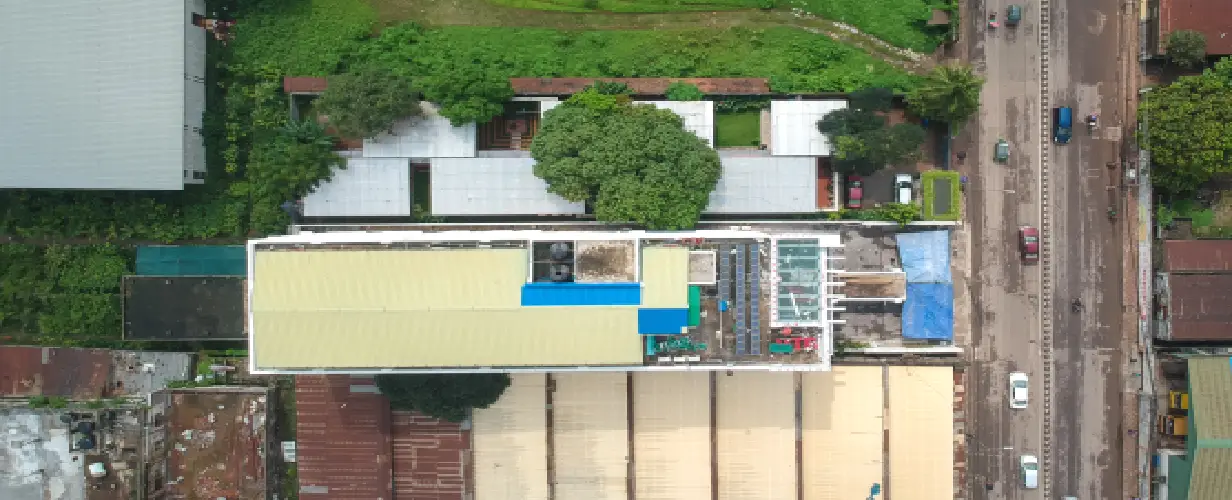
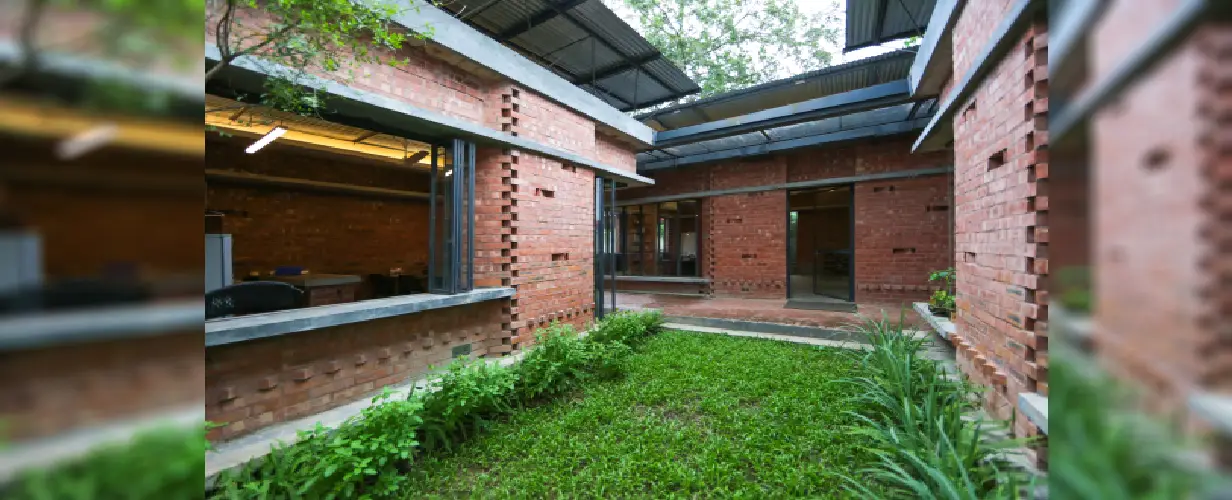
The project is located at the densest commercial area of Dhaka city. It stands out from the surrounding corporate shiny high-rise buildings in its very humble and down-to-earth structure. As it goes, the edifice and the character of its spaces stand out in the utilization and interplay of natural resources like trees, plants, waterbody, the sun, wind, rain and shadows. The architectural volume goes green rather than being a glass and concrete corporate building. This way bricks, corrugated steel sheet, custom-made mild steel frames for all the openings and cement finish floors take over expensive materials to adorn the structure with environment-friendly materials.
Low energy consumption was another goal of the project, making utilization of the shadows of the existing trees mandatory. As a result, the pods have been arranged in an alternative manner on the opposite sides of the circulation. Through this thoughtful journey, the concept of the whole project evolved as “Weaving the Nature”.
To make a very minimum circulation, which is a semi-open space bound by only one-sided wall shared with the pods, the circulation configuration has been designed straight across the site and located in the middle just between the series of pods. It also plays a role to make the structure economic, which was the foremost goal to be hit.
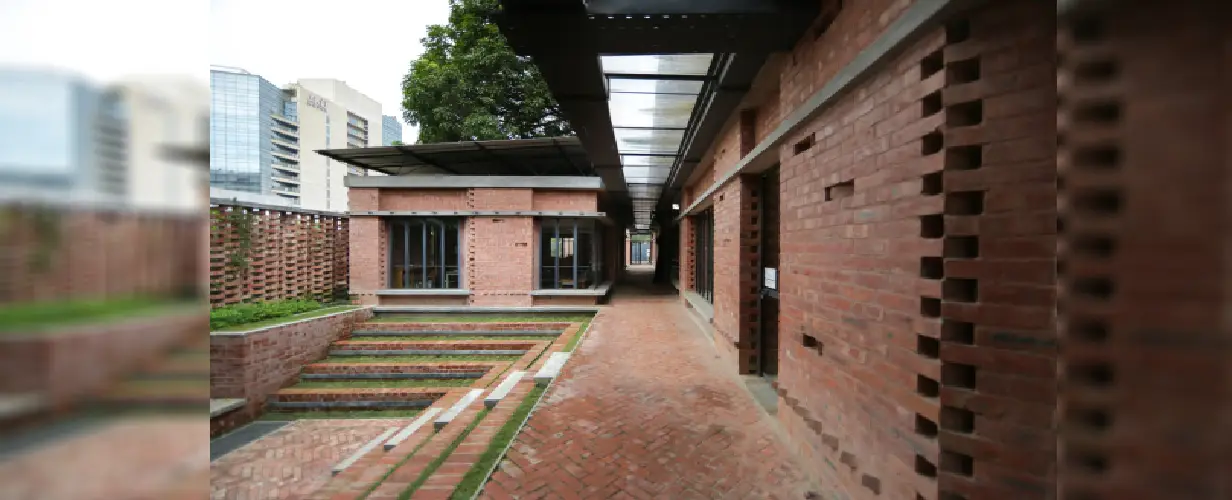
The straight but open-to-air circulation, which is full of surprises at every node of the pods, starts with a humble reception area and ends with all the services like kitchen, dining area, shower and rest rooms. The linear sky can be framed through the straight circulation spine over which polycarbonate sheet has been used as translucent canopy to let in daylight and make the spaces brighter. The trusses to hold the roofing system have been designed with customized MS rods such that it makes the structure light-weight.
Through the straight but eventful journey, one will find secured spaces like workstations, meeting rooms, training areas in various pods, which have been arranged in between the natural setting of a huge mango tree, wide grass covers, a few figs and neem trees and also some man-made landscape like an amphitheatre and a lily pond. Above all, the building spaces are arranged as if the spaces are ‘weaving the nature’.
Each of the pocket of open space between two consecutive pods has also been utilized as a common large function to be used during the leisure by a large number of users like food court, discussion area, play arena or exercise zone and even an amphitheatre, which can be covered by tensile structure during the adverse weather for accommodating hundreds of trainees to attend a workshop or lecture session.
Beside every pod, there is an adjacent open-to-air court. Each of these amicable, introverted courts acts as an oasis not only for the users but also for the neighbours rather than being a distraction to the adjacent site. These courts along with their beautiful trees make a cool working environment for the office users. And the almost see-through walls on three sides not only create a relationship between the indoor and outdoor spaces but also conserve energy, providing proper cross-ventilation.
Ancillary facilities like guard room, drivers’ waiting area with toilet and five car parking facilities have been provided at the entrance of the compound. As part of the natural green landscape, pockets have been designed on brick facades to allow birds make nests so that chirping of the birds makes for a welcome sound, keeping the chaos of the city noise at bay. And if one wants to enjoy the nature while taking a stroll across the circulation spine, he/she may decide to take a pause and take advantage of the sittings arranged on window sills at intervals.
Materials or Construction Details
The materials used in the project are environment-friendly. The provision for perforated brick screen walls was kept to let in free-flowing air all over the usable spaces. Local gas burnt bricks have mostly been used for construction. Silicon coating has been provided on top of the brick walls to make it more maintenance free. Brick dust mixture with pointing cement was a deliberate decision to render it an earthy elegance. These especially-designed brick screen walls also resemble the weaving pattern to represent the concept of the whole compound.
We have experimented with different types of brick bonding to enhance the earthy character of the building. For instance, bricks were placed at forty-five angle at the vertices of intersecting walls as if the bricks have come together to create a seamless facade. Moreover, herring bond, which reminds us of familiar pathways of rural landscape, was laid across the circulation spine to create a familiar environment.
Large multi-swing windows were designed with adjustable handles attached with each of the swings for the ease of operation. The framings for the openings were done with mild steel angle and flat section.
In order to make the project energy-efficient, multi-layer roofing system of translucent, corrugated plastic sheet roofing beneath CI sheeting has been installed. On top of the roof, trees abound, making a vivid natural canopy so that the heat from the sun dissipates very easily. Moreover, during daytime, the whole pod gets natural daylight. As a result, there is no requirement of artificial light at daytime and simultaneously the workspace remains cool and comfortable, making void the use of air conditioning. So, the project was completed within budget and was economic in fact.
Special Features
Initially, the trees previously existing on site appeared as an obstacle to design, but we overcame the challenge by using them as design elements. Finally, the trees have been preserved and seating arrangements designed under the tree canopies as a backdrop of natural setting in sharp contrast to the concrete jungle in the site surrounding.
An amphitheater, which has been so designed to host a gathering of around 100 people, is the most striking feature in the compound. The demand for a large lecture gallery, which emerges as a logical consequence of designing an amphitheatre, has also been incorporated into the design so that the outdoor space, shaded with trees, is often bustling with lively activities like discussions or gossips during the leisure, and even lectures or informal meetings, creating an exciting atmosphere.


