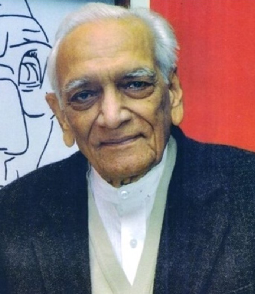
Ar. Shiv Dutt Sharma, Chandigarh
Winners of Great Master's Award
-
Project Name:
-
Year of Commencement:
-
Year of Completions:
-
Name of Firm:
-
Location:
-
Size:
-
Project type:


Project Description
Learning lessons from the legends during my formative years at Chandigarh, I developed vision for pure architecture, the importance of crystalline geometry, use of material in its original form, a spirit of minimalism, a spiritual fixation and hunger for perfection.
Adopted and Extended the philosophy of Modernism by Le Corbusier and Pierre Jeaneret an idioms of a hybrid thinking. The pure architecture and rational thoughts, building for the purpose these are meant with no superficialities, pure and honest expression, glorifying brick and cement chosen as versatile materials, to depict architectural expression for a very noble-aesthetic reasons.
MY LIFE AND MY WORKS AND ACHIEVEMENTS IS SENT .
Each work needs long explanation resolving every expect of planning, architecture, structure and services, the mystic connotations, the limitations and laws of development .
In the presentation projects only speak of the basic nature of architecture and its place in society.
More details are available in the book.
MY WORK IN THREE PHASES
1. Architect in Architect’s Office, Chandigarh:1963-73
2. Chief Architect in Department of Space-1973-1980
3. Practicing Architect -1980-Till date
PHASE – I-ARCHITECT’S OFFICE.CHANDIGARH
This was the defining formative period of Sharma’s career, where he learnt the art and craft of Indian modernism in the very laboratory where it was being developed. Learning how to design for the climate, using local, readily available materials, with absolute honesty and directness were lessons that were to stay with Sharma through his long career to come. In this sense, the Chandigarh Capital Project Office in Sector 19, which Sharma, much later would come back to conserve and preserve, was the true school of architecture of his career.
Hostel For Art College- Year:1963-64
Although built in 1963, The work has a fresh feel which denies to fade with the time. A solution with passive solar applications, an example of Sustainable architecture.
An article “Role of Indian Architects” Published in RIBA journal by Architect JR Bhalla – March 1967
Work selected for Paris exhibition
Explored Modernism and planning possibilities on a rationalized distribution of programs based on natural adjacencies i.e sun, space and greenery.
“modern indian buildings, such as CSIO cafeteria and guest house illustrate most beautifully how ancient architecture can inspire contemporary structures as they provide a link to the archelypaland scared geometry of the spiral and the circle”.
Its remarkably simple plans belie the skill with which the volumes and masses have been orchestrated to create piquant symphony of elemental modernist formal notes.
CSIO HOUSING Year: 1963-65
An attempt to plan socialistic mixed living, not with standing class or stature. Highlighting the need for terraces as extension to the covered envelope.
CLUB HOUSE FOR GOLF COURSE
Abutted in to the low mound to enrich and Year 1965-67
A distant echo of the one a the Millowners’ Association Building in Ahmedbad by Le Corbusier.
Geometrically analyzed form placed favorably to desired orientation. An architectural vocabulary viewed for the future.
STATE GUEST HOUSE Year1965-66
An expression of silence and peace. An experiment in mono textural architecture for the first time.
GURUDWARA (SIKH TEMPLE) Year1963-65
An example of symbolic architecture first in the history of Sikh Temples
Not wanting to replicate a traditional structure, Sharma evolved a structural solution working with Sikh turban as a visual metaphor.
PHASE – II-DEPARTMENT OF SPACE,GOVT OF INDIA
For Sharma, working as Chief Architect for ISRO was an exciting opportunity to explore and design major campuses in different parts of the country; a very satisfying chapter of his career. The diverse locations of projects necessitated finding appropriate local ways of working, which ranged from working with completely indigenous material and skills to deploying totally prefabricated components in isolated, island locations such as Car-Nicobar. Professional expertise included exposure to sophisticated services catering to the complex needs of space technology, use of different kinds of power and energy, magnetic shielding, creation of clean areas, precision control of humidity, temperature, noise, vibrations, etc.
VIKRAM SARABAI HALL, AHMEDABAD Year:1975-76
A dialogue between planning structure and services, classic and elegant essay in brick concrete Funicular, triangular shelves used for the first time to cover large hall.
PHASE – III-PRIVATE PRACTICE
After taking voluntary early retirement from ISRO, Shivdatt Sharma returned to Chandigarh to set up his own practise. In private practise, Sharma has had the opportunity to design a diverse range of projects from a small Bamboo Museum to massive science and health institutes. He has done both public and private projects and has encountered the patronage of clients with very limited budgets and those with more lavish. Throughout, Sharma had maintained his affiliation with the dictates of an Indian modernism, which exploring a fuller range of possibilities in dialogue with the desires and expectations of the clients.
TRIBUNE MODEL SCHOOL Year-1998-99
Introvert environment to avoid disturbance of residential area around.


