City: SRI LANKA
Ar. WMK Sapumal Bandara

Name & Location: “The Pavilion” Residential Extension @ Bamunakotuwa, Kurunegala,
Sri Lanka Cost: 30,000 US$ approx.
Built area: 1900 sqft
Unlike yesterday , giving prominence to the privacy factor in designing residencies has become one of the main concerns of persons living in both Urban and Suburban Societies. While creating privacy becomes the sole factor in designing residencies, there is very little or no concern for interaction between human beings and their natural surroundings. This has even contributed negatively towards the Psychological Dimension of persons living within such environments. Introvercy, self-centeredness, ignorance and weak human interrelations can be identified as some of these negative aspects.
Having to respond towards designing residential environment with respect to the need of privacy it is also the Social Responsibility of the Architect to contribute towards creating a healthy society. Therefore The Architect in certain situations is faced with the challenge of designing for both privacy and openness simultaneously.
The Extension to the house at Bamunakotuwa speaks about a residence located in the suburban environment. The site in which the residence is located is bordered by a mangrove swamp reservation of “Nabadana Wewa” at the rear, residences centered within 01 Acre of land plot either side and the “Wariyapola Kalugamuwa” express road which is one of the shortest routes from Colombo to Anuradhapura at the front boundary. Though the surrounding is not yet dense, the need for privacy was also the primary concern of its users due to the busy atmosphere of the road in front and the increasing litter of commercial activities developing along the other side of the road. Therefore the designer’s main idea has been to take the main activities and visual links towards the rear of the site. In doing so the designer has cleverly handled the residential building itself as a façade diluting the transition between the busy and the calm.
The residence is around 70 feet set back from the main road. The entrance to the site is a naturally formed entry that has been carved through by retaining the existing natural green buffer between the Main Road and the site boundary. Therefore the residence is invisible from the express road until the user reaches at the entrance. The in between space is a warm and welcoming forecourt turfed and landscaped with natural elements such as boulders that has been beautifully converted into benches as found from the surrounding itself centralizing a Sudu Araliya Tree (Plumeria), enhancing a private and calm interactive space. The entrance to the building is offset to the entrance of the site avoiding visual axis from the road towards the inner part of the residence. The buildings front façade is designed as a solid wall with narrow openings to avoid visual permeability towards the inner part of the building. Even the entrance is set back with a caved exposed.
brick lobby space in front that serves as a pause promoting a different mindset before entering into the residence. In terms of plan form, the building has been manipulated in a manner that main spaces that need large openings such as the living and dining spaces have been located at the rear facing the lush greenery. This has enabled the designer to have large openings at most of the rear façade enabling to create a pavilion like space linking with the exterior when all windows have been opened up. This provides the user with the opportunity to extend activities within the living and the dinning towards the elevated garden space that overlooks the coconut plantation and the mangrove swamp reservation beyond.
The residence is also rich in spatial progression and a series of surprised spaces and different volumes. One who enters the premises through the natural entry, walks through the natural rubble path way arched with Ranawara (Senna auriculata) & Kolong (Haldina cordifolia) Trees leading from the entrance to the site to the residence lobby, enters through the main timber paneled double door that focuses directly towards a Buddha Statue that is back dropped by a cement wall and glass façade providing glimpses of the environment beyond that one is just about to experience. Turning left one is warmly welcomed into the studio type living area which is both physically and visually linked towards the turfed platform enriched by the shade of Mango, Cashew and Coconut Trees. To the right the experience is to open dining space back dropped by a featured wall. Timber Attic Space is visually connected to the main space which is used as a private library.
Even the finishes have contributed towards bringing in the natural surrounding into the residence. The main feature of the building is its horizontal façade which is out of natural exposed bricks. The 18 feet high ridge wall with engraved rectangles carrying the faces of “Yoga” Hermits and the double timber paneled door which adds a featured back drop to the living cum dining area while contributing towards the quality of space. The façade is combined together with cut cement and pure white rendered walls. Exposed natural calicut tiled roof supported by the coconut rafters stained in black, texturizes the earthly atmosphere. The natural cement cut and polished floor reflects the lush greenery at the outside which creates an illusion in extending the space and earthly ambiance.
Exterior garden is 03 feet elevated from the existing ground which is a multifunctioning interactive open space and stepping down towards the coconut plantation which runs to the reservation of the Nabadana Wewa (Tank). The view from the living and dining is embraced with the natural breeze blows through the Nabadana Wewa (Tank) and the western sunset seeping through the coconut verticals which enhances the earthly finishes of the space. The rear exterior is a combination of cement and rough plastered columns painted in black that disappears into the environment contributing towards the pavilion quality and again diluting boundaries between the “IN” and “OUT”.
Ar. C. Anjalendran
Ar. Ashley de Vos (3)
Ar. Geoffrey Bawa
Ar. Kasun C. Perera

Name and location: Waraka Udawalawe, Sri Lanka
Built up area: 1390 sqm
Description of Project
A family-friendly boutique villa nestled in the lush tropics of Udawalawe, Sri Lanka where the essence of tranquility meets contemporary comfort, overlooking a beautiful waterway and wrapped by a cluster of Jack trees, draws inspiration from the jack fruit that symbolizes abundance and rejuvenation. The charming boutique villa comprises a semi-open restaurant with an infinity swimming pool, 06 deluxe rooms, 04 family rooms, 02 large suite rooms, and an ayurvedic spa with an entrance building all are crafted with eco-consciousness in mind. Each building features a unique design that blends the hues of nature with elements inspired by the jackfruit, capturing the tropical ambiance of the surrounding environment.
As the concept called “Between Trees’ of this project, every building block was meticulously designed between trees in harmony to increase the natural ambiance of the spaces where the materials lightly touch the context while maintaining privacy. Mainly, the semi-open restaurant that is raised on the ground and overlooks the water body welcomes the guests in a neutral way to embrace the rhythm of the waterway flowing near the site and seamlessly integrated into the natural topography of the site, which can be minimized site disturbance and preserve the natural environment, fostering harmony between the built environment and the surrounding landscape and it often provides breathtaking direct views of the front lake while creating a cozy yet sophisticated ambiance. The open-plan dining area that blurs the boundaries between indoors and outdoors flows effortlessly into an outdoor floating deck for relaxation. The entire property mainly focuses on eco-friendly construction, using reclaimed materials like discarded concrete light posts and used steel ‘H’ irons both to minimize waste and reduce reliance on wood as well as cost-effective, which prioritizes preserving the natural environment by avoiding cutting down any tree at the site during the construction process. The use of recycled materials fits contemporary trends and has magnified the characteristics of the buildings. Especially, the concrete light posts which become the main icon of the skeleton. A gentle peace and harmonious feeling are created by the simply modern architectural layout with a traditional architectural shape. This combination of building materials meets the aesthetic, artistic, and formal requirements while maintaining the energetic, ecological, and economic aspects as well as steel and concrete used to enhance the rustic value of the buildings.
Moreover, a fiber cement product as a green material certified by the Green Building Council of Sri Lanka has been used for the walls, ground floor decks, attic floor, ceiling, and pool decks to demonstrate a wood appearance for the space. Additionally, light features and handrails were crafted with discarded electrical fencing bobbin insulators with different sizes and colors, and cables to match the context, while other light features crafted with crack batik and waste jam bottles will also enhance the quality of inner & outer spaces. To give a smooth finish, rendered cut cement was used for the main bedroom floor areas while the bathroom floors and the front verandahs are made of steel checker plates with different colors, which aims to create independent textures with a vibrant appearance.
The color palette of this boutique villa project inspired by its natural surroundings of jack fruits & trees and the front lake, reflects the destination’s landscape, flora & fauna, which results in creating a sense of place and authenticity that resonates with guests and enhances their connection to the environment. Green and yellow colors inspired by the leaves of a jack tree, and blue color, inspired by the front lake, will dominate the entire ambiance of the spaces and create an architectural bond of a nature-friendly setup between the built environment and the natural surroundings.
Finally, to maintain the privacy of the guests, no openings or windows have been given for side walls. Natural light and ventilation directly come into the villas through the front facade only which allows to capture the front lake view through the pool. As a method of sustainable energy consumption, the entire complex prioritizes the use of renewable energy sources whenever possible and continuously strives to enhance the internal environment management practices. The extensive in-house solar farm which is positioned on the main building, staff building, and boutique villas, is currently generating 80% of the resort’s energy requirement with energy-efficient light bulbs for the entire property as well as grey water generated at the property is recycled through a purification system to reuse for gardening.
Ar. Kosala Weerasekara

A renovation of an old two storey building into a budding print shop located in the center of Colombo’s commercial district. The aim of the project to create a unique eco-friendly façade to attract customers in this urban neighborhood. Creating a green oasis amidst these modern high risers was thought of being eye catching and also would help improve the qualities of the surrounding. The facts considered when designing the interior spaces of this building are: maintaining good air quality, providing a user friendly and lively environment.
MATERIALS OF CONSTRUCTION DETAILS
Due to the budget constraints, low cost recyclable materials like wood pallets, GI pipes, pine-wood and wire mesh. The use of these recyclable materials provide great advantages environmentally and economically.
SPECIAL FEATURES
The façade being a green screen to filter out the air and noise pollution from the busy bustling streets. The foliage on this secondary skin helps to block out the harsh sun from entering the building, which in turn gives rise to a cool and productive environment. Foliage is brought in to the interior spaces which help to achieve a lively workspace. The perfect grid lines symmetrically balance the façade, creating perfect harmony which makes the building stand out well from the urban chaos. The design implemented helps make this rather small space into a much larger area.
Ar. (Ms.) Nela De Zoysa
Ar. Nihal Bodhinayake (2)
Ar. Palinda Kannangara
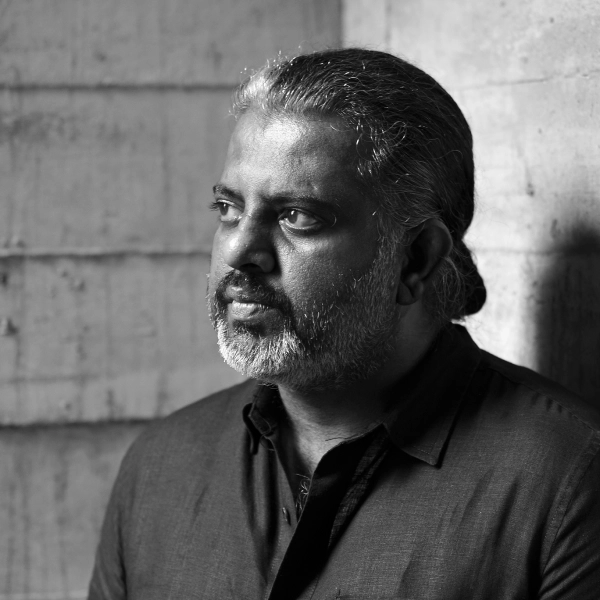
Palinda Kannangara Architects
Palinda Kannangara Architects is known for an experiential architecture that hinges on simplicity, and connection with the natural environment. The firm’s work has been recognized for contextual sensitivity, crafted material use and a minimalism reflective of the Sri Lankan ethos. Their portfolio spans the breadth of Sri Lanka, from the dry zone, to the wetlands, to the coast on a diverse palette of projects. The firm has been the recipient of several prestigious national and international awards in its 18 years of practice. Their own Studio at Rajagiriya is one of the winners of the RIBA International Awards for Excellence in Architecture 2018 and they have most recently won the RIBA International Award for Excellence 2021 for their project Artist Retreat at Pittugala and the 5th Triennial Geoffrey Bawa Award for Excellence in Architecture 2020/2021 for their project the Frame Holiday Structure at Imaduwa. The firm’s work has been featured in the recent El Croquis monograph 212.
Palinda Kannangara
Architect Palinda Kannangara has a background in Mathematics and Architecture. As a student Palinda trained under Sri Lankan modernist architect Anura Rantavibhushana, who had worked with Geoffrey Bawa for 16 years. Palinda established independent practice in 2005.


