
Ar. Vandana Sehgal is an Associate Professor in Faculty of Architecture, Uttar Pradesh Technical University, Lucknow. As an architect, she is involved with private projects like hotels, memorials, homes and interiors. She is also an artist and as an artist, she has done solo shows ‘Between Spaces’ ‘Ramayana’ and ‘Lucknow- ek nazar’ all over India. She has participated in many group shows with various artists. As an academic, her area of research is architecture theory. Her thesis was entitled The Idea of Infinite in 20th century Architecture.
City: LUCKNOW
Ar. A.P. Tyagi
Ar. Ajay Behl (Prof A)
Ar. Ashok Kumar
Ar. K.K. Asthana

Ar. K.K. Asthana, Lucknow
Ar. K.K. Asthana is the chief architect of UPRNN has thirty years of experience of working in different capacities from assistant architect to chief architect in this organisation. During this period he has dealt with all the aspects of architectural practice, right from conceptual architectural design to development of design solutions in coordination with allied multi disciplinary engineering fields and tracking project performance along with monitoring the team of architects working in the organisation. He has vast experience of designing large scale projects including Medical and Engineering Colleges. His latest projects include Engineering College for Tehri Hydro Development Corporation at New Tehri and Medical College for Uttarakhand Government at Srinagar.
Ar. Dr. Vandana Sehgal

Dr. Vandana Sehgal
Representing North India, the Jury member is Ar. Dr. Vandana Sehgal from Lucknow, U.P.
Dr. Vandana Sehgal is an architect, an artist and an academic. As an academic, she has been teaching architecture since 23 years. She is currently the Principal and Dean of Faculty of Architecture and Planning, AKTU. Lucknow.
Ar. Vandana writes regularly in journals on theoretical aspects of architecture, cultural theory, pedagogy and practical design issues.
As an artist, she has done solo shows ‘Between Spaces’ ‘Ramayana’ ‘Lucknow- ek nazar’, The Woman and Krishnaa” and has participated in group shows with various artists all over India. She has painted Illustrations for reputed authors and publishers. She has curated many exhibitions like ‘White on White’, ‘Sanctums’ etc.
As an architect, she is associated with design projects like Extension of State Archives, Lucknow, Documentation, Conservation and adaptive re-use of historical buildings like Chhatar Manzil and Lal Baradari Lucknow, documentation of many areas of Varanasi, and planning projects like Ru-urban scheme of GOI through institutional consultancy.
She is also associated with some private projects like hotels, memorials, homes and interiors in an honorary consultant’s capacity.
Ar. Rajat Kant
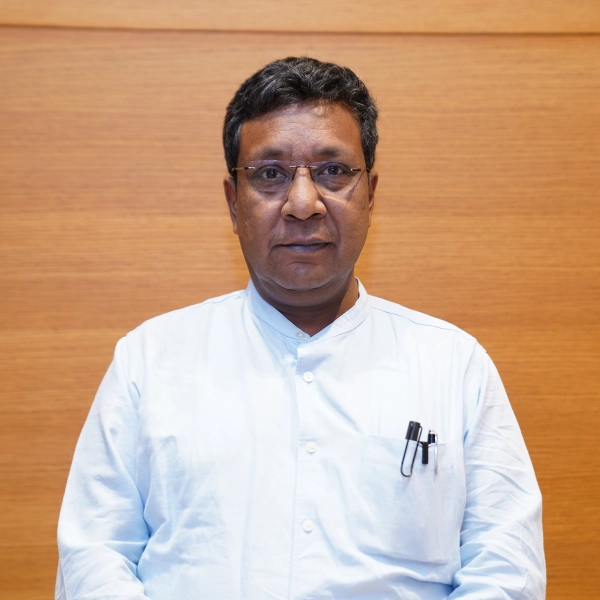
Ar. Rajat Kant (Professional Advisor 31st JK AYA): Ar. Rajat Kant is an architect and has a master’s in Urban Design from School of Planning and Architecture, New Delhi, India and another master’s degree in Housing Environments from University of Illinois, Urbana Champaign U.S.A. He practices out of Lucknow and has interest in morphology of his city about which he writes all over. Apart from practice, he teaches across many schools of architecture and design with a keen focus on qualitative understanding of built environments. Cultural production of spaces is a major exploration which he is still trying to understand. In his spare time likes to watch people and experiment with fountain pen inks. His favorite being Yama Budo from Iroshizuko.
Ar. Asheesh Shrivastava

URBAN LANDSCAPE DEVELOPMENT AND REVITALIZATION PROJECT OF HAZRATGANJ PRECINCT
Hazratganj is one of the most important commercial hubs of the city of Lucknow. It has been the popular image of both the historic and contemporary Lucknow. This street is a heritage precinct with 200 year old legacy. Its foundation was laid by Nawab Saadat Ali Khan (1786-1814) 200 year ago. He moved away from the congested old city & developed whole new stretch along Gomti River called Hazratganj. It was formally developed as shopping street by Nawab Amjad Ali Shah whose mausoleum (a nationaf Protected monument) is located on same street. Most of the Hazratganj area was destroyed during the First War of Independence 1857.Most of the buildings which we see today are of the British era after 1857. By the Independence in 1947, Hazratganj became an elite market with exclusive entertainment facilities. Semi-circular arches, jack-arches, I-girders, Metric bricks & metal railings characterize British construction Our mandate was to Restore and Revitalize Hazratganj Main Street: the high street of city of Lucknow.
hazratganj : A Brie Histo
I. Founded by Nawab Saadat Ali Khan in 1798, completed in 1810 and named after Hazrat Ali
2. Inspired by Calcutta’s Chowringhee.
3. Hazratganj remained LucknoWs main connector road in Robert Napier Plan
4. Facade makeover started in 1858 and the removal of thatched roofs commenced
5. By 1871, Hazratganj acquired a colonial British look
6. Used to be the Queen’s Way the jugular vein of the British
7. British believed that those who controlled Hazratganj controlled the city
8. Originally conceived to extend from Kothi Noor Baksh to Dilkusha
9. Remained the main route for British soldier marches, nawabi carriages and Muharram processions
10. Two impressive gateways at both ends of Hazratganj were later demolished
11. An old Catholic church demolished as late as in 1970’s
12. Ganjing is a term used to describe roaming around in the wide lanes of Hazratganj
13. Hazratganj today is Lucknow’s city centre and the premier and posh marketplace
14. Rejuvenation undertaken in 2010 to mark its 200 years’ in a partnership between State Government and ‘Hazratganj Traders Association’.
The dynamics and problems of Heritage precinct like Hazatgani
Hazratganj is Lucknow’s primary commercial hub. Such heritage precinct has had several tenants typically a ground-floor retailer and, frequently, several upper-floor offices or apartments; together, these tenants provided enough rent for property owners to keep their buildings in good condition. The presence of the cinema halls, library, banks and local government offices added to the steady flow of people to this area. Not only was Hazratganj the centre of the Lucknowites commercial life, it was also an important part of its social life; people thronged the street on Saturday and Sundays nights to meet friends, see a movie and window-shop.
In the past 20 years Hazratganj has changed drastically. The rapid urbanisation in past decade has resulted in growth of suburban centres with shopping malls and multiplexes occurring outside traditional areas. Improved transportation routes people find it easier to travel to these suburban malls and new commercial hubs. The sprawl with its Gomti Nagar style architecture that that reflected neither a sense of place nor a sense of pride, and became an issue that most communities contend with today The business in Hazratganj were low forcing traders to shift or extend their activity to malls, dwindling the property values and also sinking the spirit of the street under its own apathy. Neglected buildings, dangling hoardings , masked shops fronts hiding beautiful architectural facade, trash strewn street gradually had reinforces the public perception that Hazratganj is not a happening place.
People have forgotten how important their Hazratganj is and its historic commerciai buildings were reflecting their community’s unique heritage.
Some of the property owners, tried to halt this spiral of decline by imitating their competition — the shopping mall. Their attempts to modernize Hazratganj take the forms of pedestrian malls, covering or changing traditional building facades with aluminium claddings, and attaching huge, oversized signs on their buildings to attract attention. These well-meaning but usually ineffective methods did not stabilize Hazratganj’s decline, mostly because they did not address the fundamental problem.
Present movement has however assessed the root cause and carefully understands the importance of saving heritage and one’s own identity as a process to restore both tangible and intangible aspects of Hazratganj explained before.
Issues before intervention:
There are some key issues which have been considered in Redevelopment of the Hazratganj Area.
Lack of pedestrian facility
Lack of public amenities
Large scale hoardings, signage and banners
Indiscriminate parking and traffic chaos
Collapse of infrastructure services.
Lack of organized open public spaces
Need for green spaces/ ecological environment
Encroachment
Haphazard overhead electrical wiring
Lack of architectural control
Concept: Clean, Safe, and Green Hazratganj.
We have tried to Revitalise not only the tangible aspect, such as street facade and street elements, but also conserve intangible aspect of Hazratganj i.e. the Experience of Ganjing. Thus concentrating on bringing back the glory and celebrate the spirit of Ganjing.
Conservation approach is a community-driven, Government supported comprehensive strategy. Probably for the first time in Indian history we saw such consensus and likeminded approach towards preservation for our heritage and identity.
To highlight and emphasize the pedestrian nature of Ganjing, we have actually introduced continued stretch of path way for entire Hazratganj street (scooping out from painted road) as main feature of present program. These are the areas of public interaction. The footpaths are not just walkways; they have all elements of an urban space. The footpaths are designed with barrier free access to differentiy abie persons. They have post-op lanterns, benches and dustbins all designed in sympathetic architectural style.
Views and vistas into and out of these streets add to the important streetscape qualities of Street have been considered while designing. The seats, trees, lamps and other street furniture will help make Hazratganj Street a very pleasant environment for people.
Proposal:
Major highlight of the project include:
Restoring character of the street
Improvement of Views and vistas
Development of activity nodes and piazzas for general public
Restoration of architectural features
Development of Open Spaces
Concept of active living: our design encourages people to walk and enjoy the carefully
designed meeting places and piazzas
Introduction of softscape in the area
Improvement of infrastructural facilities (like underground wiring and data cables, water supply, storm water drainage system)
Materials used
Specially designed street furniture has been embroidered along the main axis to strengthen the main character of this zone. To recreate the romance of the past Victorian Lamp posts, Benches, Railings and other Street Furniture like telephone and police booth were integrated into the design. All street furniture were purposefully designed and executed in cast iron. Mild steel was other material used in combination for some of the furniture.
For Pathways Cast in place M-30 reinforced Stamp concrete has been used. The technology developed in California can give any heritage look finish to the surface by using color hardeners and stamp frames. Cobble stone finished in Chunarstone matching brown color was used in this case. The execution is 10 time faster than normal stone.
About 30% Of the area has been converted into green. All architectural features are in Victorian style celebrating the colonial architecture of the precinct. Any incompatible element or structure (hanging wires, encroachment in original profile of the building or hoarding covering fagade of structures) were removed and services were made underground enhancing the aesthetics of the site.
Architectural features of the facade have been restored through a complex procedure. Our Team had documented the architectural features of the street and luckily we have plenty of them in place and which gave us enough information to restore them. The area in general is characterized by an assortment of colonial facades, some properly adorned with decoration, others bare. The individual facades are generally narrow. When the facades are wide they are subdivided into a series of bays, thus providing continuity to the rhythm of the streetscape. The precinct as a whole is both historic and of architectural merit. Our effort was to fill in the gaps obscured due to passage of time.
After revitalization project the rentals have increased by 100% in the area while property prices also have taken steep rise. The footfall to the area is now almost four fold. The revitalization is a continuous process. Once on move, it will start the spiral effect bringing people to the area and thereby increasing economic viability of the area. If we respect our identity and our heritage I have no doubt that it wifi sustain. involvement of alf stakeholders in decision making, makes the process more sustainable as it gives sense of ownership to all.
Ar. Jadon Rahul
Company Brief
Node urban lab is an interdisciplinary team of Architects, Designers and Urban experts who collaborates, connects and creates. It is the ultimate outcome of the inter-weaving of the various threads of a project to bring about design and innovation.
Node Urban Lab has started its journey with a vision to make earth a symposium of creativity, innovation and design. We believe in converting constraints to opportunities and envisage flexible solutions that anticipate future change. We establish the vision, identify the means, and develop a framework for action with an aim of generating long-term economic, social, and environmental value for clients and communities.
We constantly advance the development of new tools and push innovative thought for design, planning and communication. We embraces new design technologies with a focus on computational design and fabrication, Artificial Intelligence, AR/VR and Mixed Reality.
Rahul Jadon | Managing Partner and CEO | Architect & Urban Planner
An Archipreneur and Co Founder at Node Urban Lab.
Pan Profile:
Rahul Jadon is an Archipreneur and founding Partner at Node Urban Lab and Estandardz. He has studied architecture from GCA Lucknow and has completed Masters in Urban and Rural planning from IIT Roorkee. His work, academic as well as professional, has achieved widespread acclaim, and has been lauded in leading magazines and journals of architecture and development studies.
His belief in undertaking a Design approach to solve problems of all scales have led him to undertake parallel projects in architecture, interiors, heritage conservation and urban development.
He has worked with Ar. Yatin Pandya and has collaborated with leading architecture firms of north India on various projects and competitions. He has won Queen Hu Memorial competition and recognized for his works including Birla Yuvaratna Award, AD ET-Edge award, NASA- Archidesign Thesis of the year award 2014 and aced Archumen Architectural Quiz competition. He was invited to CEPT University and presented his graduation project in Karula Varkey Design Forum 2015. He has worked under HRIDAY project at NIUA (National Institute of urban affairs) and MoUD (Ministry of Urban development).
Currently Rahul assists the many organizations on its flagship Development projects and working as an architectural Urban planning Consultant. Node Urban Lab has been established as a successful startup, and Rahul & team continue to propagate it as business demands.
With an urge to bring innovation, he is currently working on an idea for disrupting the AEC industry in design, construction procurements and project management.
Work Experience
2017-Present- Managing Partner at Node Urban Lab LLP
2016-2017: Architectural and Planning Consultant to Go UP, World Bank, Faculty of Architecture, AKTU Lucknow and other reputated organizations.
Accomplishments
Have won national recognition for my works including Birla Yuvaratna Award, AD ET-Edge award, NASA- Archidesign Thesis of the year award 2014, and aced Archumen Architectural Quiz competition.
I was invited to many forums and platforms including Karula Varkey Design Forum, Archotsav, srijan, etc. I have worked under the HRIDAY project at NIUA (National Institute of urban affairs) and MoUD (Ministry of Urban Development).
Rahul Kardam | Managing Partner | Architect
A passionate architect and Co Founder at Node Urban Lab.
Expertise is to conceptualize and develop innovative forms and drive the operations part. Idea to create experimental parametric forms, modular designs, cost-effective interior solutions, and execute them up to the imagination.
Work experience
2017-present: Co-founder Node urban lab LLP
2014-2017: Architect at Faculty of Architecture Consultancy cell, GCA Lucknow
DINE ON STEPPE!
“IMBIBES THE NATURE ” the café inspired by the Terai region of the Himalayan belt, eastern UP. This space plays host to
a café and dining with a natural and healthy environment experience that captures the visitor’s attention from the very start. Upon entering, the visitor is instantly transported to a terrain region,characterized by greenery that reflects
the lowland region lying at the foot of watershed intake on sustainable design. The coreidea is to make a Green Building
café ny not installing solar panels, conserving water or reducing their use of electricity. but other decor elements
play a substantial role in creating a healthier environment too. Natural materials , floor coverings and architectural design elements that use these renewable materials.
The concept is to wield the Green space in rustic themes by Natural Finishes. The intent is that every visitor feels the outdoors from inside the restaurant, this also elevates the verall vibe of the space. Consideration for Green Interior:
1. Minimalistic Interior for Decreasing Carbon Footprint Providing plants in indoor spaces to balance the indoor Air Temperature
2. Conserving of Natural Resouces by use of Natural materials like Traditional clay tiles in floos/walls and Exposed surfaces
3. Clear Glass Window in NE Facing gives a natural light and Ventilation
4. Use of Low VOC Wall finishes which act as thermal insulation.
5. Use of Less energy Consuming LED Lights
There is a much bigger focus on the emotion involved by the ambiance of the space. Afriskiness continues on the surfaces, fixtures, and furniture across the restaurant. The restaurant features custom in-situflooring with textured ceramic tile inlay
in the sitting zone, exposed ceiling, and printed chairs with raw wood finish tables thatfurther augment rustic themes. Rustic
hues, curved lines, and green images draw one in through a small and inconspicuous space, into a cozy yet minimalistic entryway dotted with indoor plants and ceramic wares.
The color palette consists of warm Indian yellow, shades of turquoise, and plenty of natural raw wood finishes. The use of natural fire bricks cladding on the entrance wall as the café rear walls, a suspended metal shelf with creepers warms up space. Another wall is clear glass that gives maximum illumination and a clear visual connection for the visitors. The interiors overlook a live kitchen that makes it easily visible to customers from either end of the space.
For the private space, the design approach is to play with architectural materials by using traditional patterned ceramic tiles as flooring, geometric patterned wooden paneled walls, and contemporary parametric ceiling makes space unparalleled and thrilling.
An impressive suspended ceiling that creates the effect of waves embedded with lights that illuminate the whole space, metal and wooden lamps with plenty of creepers and strip lights make an Avant-garde statement. The lux levels and warmth created by the lighting are paramount to get this effect.
Warm white lighting brings vibrant vibes to an otherwise yellow canvas, we looked closely at lighting as an art, to maintain the minimalistic approach. And thus had a successful close-working relationship with our lighting. To have an ambiance that is completely novel and modish overall and feels. Plenty of artificial planters have been used to adorn the space dividers,” planters can be expressive as works of art with the right lighting”.
The design approach allows the shadow to play a stimulating role as well. We created different clusters of lights to define the different spaces and intentionally light the surface and object. “Fluvial, waves of Terai” depict the façade design, which is establishing a visual connect with the populace. These ideas took us beyond the fascia and intrigued us to get it reflected in the ceiling which imitates the parametric design and is inspired by the natural palette of the terrain region. One of our design challenges was to erect the façade through indoor space by a wave ceiling which acts as both functional as well as aesthetic.
Where we make a parametric counter by providing a fluidity effect in its design. Along with aliment, ambient and tactful creativity, Terai takes a magnificent sentiment that provides travelers wholesome wisdom of fascination, curiosity, exploration, and bliss. It fascinates a visitor in virtuosity and amazement who approach it. Till you finally walk away, decidedly eager to return. Terai packages everything that one expects from a comestible destination.


